
Photo: EPA
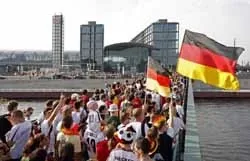
During the 2006 World Cup, tourists spent €1 billion
The recently concluded FIFA World Cup in Germany was visited by about 2 million tourists - twice as many as the country's authorities had expected. According to experts, half of the guests visited the country for the first time, and the vast majority of tourists liked Germany. In total, during the championship, fans spent €1 billion, and the Germans themselves spent even more - about €3 billion. In addition to the sports excitement, sales were boosted by 30-degree heat. Cafes and bars worked at full capacity – excited football fans bought beer and soft drinks in bulk.
Southeast Asian countries want to introduce a single visa
At a meeting of representatives of national tourism companies of ASEAN member countries in the Thai city of Chiang Mai, the issue of introducing a single entry visa in these states was discussed. As reported by Tanita Manichote, director of the tourism development office of Thailand's Ministry of Tourism and Sports, the first step has already been taken: an agreement has been signed to unify the visa space of Thailand and Cambodia.
The Association of Southeast Asian Nations (ASEAN) includes ten countries, including Indonesia, Malaysia, Singapore, Thailand, the Philippines, Vietnam and Cambodia. According to Manichote, the introduction of a single visa in these states should lead to an increase in tourist flow and, as a result, an increase in income for the region's tourism industry.
Participants in the tourism market approve of the Thai authorities' initiative, but do not expect too much effect. According to them, consular fees in the most popular Asian countries are not that high and are unnoticeable against the overall cost of tour packages to Southeast Asian countries. The introduction of a single visa will rather help tour operators save time, making it easier to organize combined tours.
Budget hotels to appear in Dubai
Reef Real Estate Investment Company has announced its intention to build ten budget hotels in Dubai over the next two years. The first of them, in the Al Barsha area, will open in early 2007. Three hotels are at the project preparation stage, two hotels are under construction, and the remaining five are still only in the planning period, reports DTKM-Moscow.
As the head of Reef Real Estate stated, the company's goal is to add 2,000 hotel rooms to the emirate's hotel stock by 2008. The total cost of the project is $500 million.
This is a necessary and timely step for the emirate's tourism industry. To date, according to various studies, Dubai hotels remain among the most expensive in the world, which leads to instability in the local tourism market and numerous booking cancellations. According to experts, the presence of hotels only in a high price category will not allow achieving the goal set by the emirate of Dubai - to bring the number of tourists to 15 million people a year by 2010.
Ireland and Belgium – the safest holiday
A ranking of resorts in terms of various kinds of troubles was compiled by the British insurance company Norwich Union Travel Insurance. Its experts analyzed the statistics of compensation to tourists who traveled abroad - a total of 60,000 claims made in 2005.
It turned out that British travelers most often apply for compensation for insured events when returning from Thailand. There are the most accidents, food poisonings, and household thefts. Victims of robberies (including armed ones) were most often vacationers in South Africa. In addition, luggage most often disappears there.
It is most dangerous for snowboarders and skiers to be in Austria - that is where ski injuries most often occur. Those with allergies should avoid the Caribbean basin: in this region, the danger of bites from poisonous tropical insects is especially high.
Most unnoticeable thefts occur in the Czech Republic: here a tourist has the greatest chance of becoming a victim of a pickpocket. And the safest countries for vacationers were Ireland, Belgium, the Netherlands, Germany and France.
“We did not set out to scare tourists,” says a representative of Norwich Union Travel Insurance, “we just wanted to show them what mistakes should not be made.”
Athens increases fines for fare evaders
Starting July 20, fare evaders on Athens public transport will pay a fine equal to 60 times the ticket price. The step is aimed at reducing losses of tens of thousands of euros caused by the reluctance of city residents and tourists to pay for travel. In addition, by the end of next year, the Athens metro will introduce a new distance-based fare system. This project will later cover other transport: electric trains, trams, city buses and trolleybuses, reports “Your Greece”.
Smoking to be banned in Thai temples
Thailand's National Foundation for Tobacco Control intends to turn the country's Buddhist temples into “no-smoking zones.” The goal of the program is to get monks to quit smoking during the Buddhist Lent, after which they could become role models for smoking parishioners, reports “Your Thailand”.
The foundation's representatives will hold special classes with temple servants, and also help them prepare sermons that can help believers get rid of this bad habit.
In the USA, the fate of the cent is being decided
A proposal has been submitted to the US Congress, initiated by Arizona Republican Congressman Jim Kolbe, to remove the country's smallest coin from daily circulation. The arguments are simple and virtually indisputable: one-cent coins have lost value. Currently, the number of coins in circulation exceeds 130 billion. Moreover, many Americans, avoiding extra weight, do not carry them in their wallets, preferring to throw them into a home piggy bank, where they lie for years.
As a result, the mint is forced to strike more and more batches. So, last year, 14.3 million new coins were put into circulation. Producing each of them costs 0.8 cents, and taking into account transportation and distribution costs, minting cents threatens to become unprofitable.
The congressman's proposal does not provide for the abolition of the cent as such. If the bill is approved, these coins will simply not be needed, since the law will require the retail trade sector to round prices for goods. For non-cash payments, the price will still be indicated to the nearest cent.
However, the congressman's proposal met with public resistance. According to estimates by the organization “Americans for Common Cents” (and such an organization exists in the US!), as a result of rounding retail prices, additional expenses for the population could amount to up to $600 million per year.
Legislators have attempted to encroach on small change before – in 1990 and 1996, but both attempts to remove the coin from circulation were unsuccessful.
Hong Kong will work without ties and jackets
In the very near future, the atmosphere inside government institutions in Hong Kong will become much less official - the city government has proposed that officials voluntarily refuse to wear ties and jackets in the office. All 160 thousand officials have been officially offered to come to work in “less formal but decent clothing”.
The fact is that the government intends to raise the temperature inside buildings to 25.5 degrees Celsius from the current 22-24 degrees by reducing the capacity of air conditioners used for cooling. According to economists' calculations, this measure will save more than $100 million annually and reduce harmful emissions into the environment by thousands of tons per year. According to Hong Kong authorities, more than a third of electricity consumed in the SAR is used for air conditioning.
More than three hundred Hong Kong companies have also already announced that they will join the initiative and allow their employees to come to work without ties and jackets.