
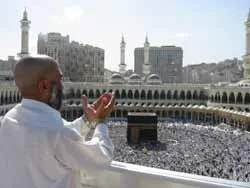
Saudi Arabia plans to become a tourist country
Perhaps, by the end of this year, tourists from all over the world will be able to visit one of the most closed states in the world - Saudi Arabia. The largest country of the Arabian Peninsula is ready to allow the issuance of entry tourist visas, reports the newspaper Asharq al-Awsat. Thus, not only Muslim pilgrims will now be able to get acquainted with the numerous sights of the Saudi kingdom, where the main world shrines of Islam are located.
Such intentions were announced several years ago, but only now the country has begun to take concrete steps in this direction. According to the authorities, in June a specially approved commission will begin preparing a new tourism law in order to present the finished document by October.
Riyadh expects that already in the first year of the new entry regime, about 1.5 million tourists will visit Saudi Arabia. And this is in addition to the 2 million pilgrims who annually perform the Hajj to Mecca and Medina in fulfillment of one of the five commandments of the religion of the Prophet Muhammad. The Saudi authorities expect that tourism will become a significant source of growth for national welfare, which is based on oil. According to calculations, the new sector of the economy can generate up to 16% of Saudi Arabia's GDP.
In recent years, Saudi Arabia has begun to pay attention to the development of the tourism sector. In addition to the sea and sun, the kingdom can attract foreign tourists with its rich historical and architectural heritage: the country has about 6,400 monuments and attractions. However, strict moral and behavioral norms, a dress code for women, a ban on alcoholic beverages, and restrictions on the entry of non-Muslims have always been an obstacle for foreign tourists. Thus, in 2005, the Saudi Foreign Ministry issued only 5,500 visas for diving enthusiasts from Western countries.
EU countries opened labor markets for guest workers
Since May 1, most of the "veteran" EU countries have fully opened their labor markets to guest workers from the East. All states of the former composition of this regional organization, with the exception of Belgium, Italy, Finland, Luxembourg and the Netherlands, have made the necessary changes to national legislation prescribed by the EU directive on the free movement of workers. In other EU countries, citizens from the new EU member states no longer need to obtain a work permit.
According to the requirement of the European Commission, five countries that have kept protectionist measures in force must review their decision in two years. At the same time, restrictions on guest workers from new EU countries must be completely lifted by 2011.
According to the European Commission, the United Kingdom, Ireland and Sweden, which fully opened their national labor markets to citizens of new EU member states on May 1, 2004, have seen significant economic growth, a reduction in labor shortages and unemployment. Improvements in economic indicators and a reduction in labor shortages were recorded in other countries of the former EU.
Overall, across the 15 states, 12 of which introduced restrictions on the employment of guest workers from the East on May 1, 2004, the number of people from new EU states reached, according to the European Commission, less than 1% of the total working-age population. The exceptions are Ireland (3.8% - in 2005) and Austria (1.4%).
It has become more difficult for Ukrainians to find employment in the UK
Working conditions for Ukrainian workers in the UK have noticeably deteriorated after citizens of new EU member states were given significant privileges in employment. This is the conclusion reached in its report by experts of the British foundation Joseph Rowntree Foundation, which specializes in social problems.
As part of the study, Ukrainian and Bulgarian migrants were interviewed as representatives of European countries that are not yet EU members. Another focus group included migrants from four new Eastern European EU member states - Poland, the Czech Republic, Slovakia and Lithuania, for which the UK abolished all employment restrictions in May 2004.
Four low-paid sectors of the economy were considered: construction, agriculture, home childcare and hotel industry. It turned out that working conditions for new EU citizens in Britain have changed for the better. 70% of respondents in this group think so. They got paid holidays and sick leave, and pay increased. Almost 60% said that it has become easier for them to find a new job.
At the same time, more than two-thirds of Ukrainians and Bulgarians said that it is now harder for them to keep their jobs or find a new one. 30% of respondents felt a deterioration in working conditions.
The results of the study confirm that the new opportunities that have opened up in Britain for citizens of new EU countries significantly reduce the chances of other Eastern European workers in the labor market.
Sudan named world's most failed state
Sudan is the most unstable country in the world. This state occupies the first line in the ranking of failed states, compiled by Foreign Policy magazine and the Fund for Peace. The study involved 148 states, reports the Guardian newspaper.
The top three also included the Democratic Republic of the Congo and Côte d'Ivoire. Iraq ranks fourth in the ranking, and Afghanistan closes the top ten.
At the same time, Russia is ranked 43rd, between Tajikistan and Niger, and Belarus was placed 50th by the report's authors. Uzbekistan, which took 22nd place, was recognized as the most "failed" republic of the former USSR, Kyrgyzstan is in 28th place, Moldova got 57th place, and Georgia is only in 60th position, closing the ranking.
In their calculations, the authors of the rating used 12 social, economic, political and military indicators. In addition, information was collected on the basis of 11,000 available sources published from July to December 2005. At the same time, as the researchers note, most of the countries included in the rating cannot yet be classified as failed, since the authors of the list calculated primarily the level of danger that a particular state may be exposed to in the future. In particular, we are talking about the possibility of an internal armed conflict.
Finland has made seat belts mandatory for both drivers and passengers
Finland is tightening the rules for road transport: from May 1, the use of seat belts has become mandatory. The innovation now applies to all vehicles.
From now on, even bus passengers and truck drivers must use seat belts where they are fitted. Violating these rules carries a fine of €35. The rule also applies to tourists traveling by car.
These measures will make trips on the country's roads even safer. According to statistics, over the first few months of this year, 52 people have died in car accidents in Finland. This figure is one of the lowest in recent years. For example, last year the number of road accident victims in Finland was 94.
Based on materials from news agencies.