
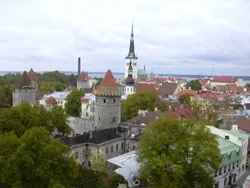
Estonia simplifies entry into the country
Last week, the Estonian parliament passed amendments to the law "On Foreigners" that will significantly ease the visa regime for citizens of non-EU countries. Now those who wish to come to the Republic of Estonia for up to five days "for tourist or recreational purposes" no longer need to wait for an invitation from relatives or friends living in that country, according to Novye Izvestia.
The explanatory note to the amendments to the law "On Foreigners" notes that the changes will primarily affect tourists from Russia, who make up 90% of all visitors arriving in the country on visas. As press secretary of the Estonian Foreign Ministry Ehtel Halliste said, "now, to obtain an Estonian visa, citizens of non-EU countries will only need to provide to the Estonian Foreign Ministry (embassy, consulate) documents confirming that this will be a tourist trip (return tickets, a voucher from a travel agency and hotel). Also, the entrant must prove that he has funds to live on during his stay in the country. This is a standard procedure for all EU countries."
True, there were opponents to the new amendments in the Estonian parliament. Deputies representing the nationalist-radical party "Fatherland Union" the day before the vote called on their colleagues to vote against amending the law "On Foreigners." They explained their position by saying that easing the visa regime should be bilateral and strongly asked parliament deputies to return to discussing this issue only after the Russian side "also spoke in favor of greater freedom for tourists from Estonia and abandoned registration of visitors." Nevertheless, by a majority of votes, to the delight of tourists, Estonian parliamentarians voted for the adoption of the amendments.
Poland to tighten entry rules
Starting December 1, 2005, the Polish border service intends to tighten checks on availability of funds to cover treatment-related expenses or medical insurance policies for citizens entering the country. This was reported by news agencies citing the Consulate General of the Republic of Poland in Kaliningrad.
According to a decree of the Polish interior minister, every foreigner over 16 crossing the state border must have funds at the rate of 100 zlotys (about $30) for each day of stay, but no less than 500 zlotys or the equivalent in another currency, as well as medical insurance covering treatment costs. As reported by Rosbalt news agency, if such funds or documents are absent, the foreigner will be denied entry into Poland.
What will be recorded on the chips of new foreign passports
Issuance of new-style civil, service and diplomatic foreign passports will begin in Russia on January 1, 2006. This was announced by the head of the administrative department of the Russian government apparatus, Mikhail Lychagin.
The feature of this document will be that an electronic chip with information about the passport owner will be embedded into the foreign passport. Lychagin explained that at present it will be the same data that will be printed on the title page of the passport, and a digital photo. No additional information will be put on the chip for now. Subsequently, the department head explained, if the world moves to adding fingerprint or retina scan data to documents, such information could also be entered on the chip.
Passports issued before January 1, 2006 will remain valid for their full term. For some time, passports of both types will exist in parallel. From January 1, passports of both the old and new model will be issued, which will be valid for the full term – 5 years.
57 thousand illegal immigrants deported from Russia this year
In 2005, about 57,000 illegal migrants were deported from Russia. Such data were presented by the head of the Federal Migration Service of the Russian Federation Konstantin Romodanovsky at parliamentary hearings in the Federation Council.
"In 2004, more than 104,000 people were brought to administrative responsibility for violating migration legislation, and 49,000 in the first half of 2005," Romodanovsky also said. He noted that deportation of illegal immigrants was carried out by court decision in accordance with the procedure established by law.
Currently, according to the head of the FMS, there are 114 migration control posts in Russia at checkpoints through which about 70% of passenger traffic passes.
Every fifth Moldovan works abroad
Every fifth rural resident of Moldova and every tenth city dweller has gone abroad to work or in search of work. According to the National Bureau of Statistics (NBS), over the past three years the number of labor migrants has increased by 186,000 people. By the beginning of autumn it exceeded 420,000.
Abroad there are 28.8% of the total inactive population of Moldova, or those who have never had work experience in the republic and are not registered as unemployed. Two-thirds of labor migrants are men. Of these, almost 71% are from rural areas.
Statisticians report that the number of economically active population in Moldova has decreased by almost two percent - to 1 million 364 thousand people. In some sectors of the economy (in particular, construction), a shortage of skilled labor has become noticeable.
According to other sources, up to 900,000 people from Moldova currently work abroad. The difference between the data of the National Bureau of Statistics and the International Organization for Migration (which says that the number of labor migrants from Moldova reaches almost 600,000) is explained by the fact that the NBS counts only citizens for whom there is confirmation that they travel for seasonal and temporary work abroad, reports IA REGNUM.
France intends to introduce a tax on air travel
The French government has approved the introduction of a tax on air travel. It is expected that the collected funds will go towards fighting poverty and various diseases in developing countries.
If the bill is approved by parliament, the tax will be levied from July 1, 2006. It will be about €1 for economy class on European flights and about €4 on long-haul flights. The French government hopes to raise more than €200 million in a year. According to the Associated Press, airlines and tour operators are opposed to the "solidarity tax".