
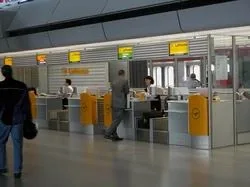
In Germany, Lufthansa speaks Russian
At Frankfurt and Munich airports, Lufthansa passengers arriving from CIS countries are now greeted by Russian-speaking airline employees. Agents of the special Welcome Service meet arriving guests at the gate to help them find their bearings and provide details about connecting flights, where to collect baggage, customs formalities, and much else that a passenger may need, the airline said in a press release.
Ukrainian migrant workers protest in Britain
About 250 agricultural workers from Eastern Europe, among them many Ukrainians, held a protest against harsh working conditions and low wages, Interfax-Ukraine reports. The protesters blocked a highway in central England.
The Eastern European workers were legally hired by S&A Produce and work near the town of Leominster at Europe's largest strawberry farm. Most of them are outraged by the working conditions. For example, 22-year-old Ukrainian Konstantin Kravchuk said he paid €600 to an intermediary to get into this program, yet he was paid only €900 for 10 weeks. Another protester, Olga Volodkevich, said: “We are treated like animals.”
Workers also complain that they have to return a large part of their earnings to S&A Produce: €40 per day is taken for accommodation in a trailer, about €5 for sewage and garbage collection, €3 for electricity. Almost everyone has to pay from €450 to €750 to British intermediaries who arrange legal work for foreigners.
Australia tightens rules for obtaining citizenship
As part of its counter-terrorism campaign, Australian authorities intend to tighten citizenship rules. As Gazeta.Ru reports, Citizenship and Immigration Minister John Cobb stated this in an interview with Sky News.
According to him, the number of years required to reside in Australia to obtain citizenship will double to four years. In addition, checks on citizenship applicants will be significantly tightened.
Slovakia continues processing free visas for Ukrainians
The Slovak government has extended the processing of free short-term visas for Ukrainian citizens until July 2006. As RIA Novosti reports, Slovakia's ambassador to Ukraine, Urban Rusnak, announced this.
Rusnak justified the Slovak government's decision by “an interest in seeing Ukraine move closer to the European Union.” “We recognize the transformations that have taken place in Ukraine since the Orange Revolution. And we believe that our positive experience will help develop bilateral relations between Ukraine and Slovakia,” the ambassador noted.
Earlier, Slovakia abolished fees for short-term and transit visas for Ukrainian citizens for the period from May 1 to August 31, 2005. Poland, the Czech Republic, Estonia, and Lithuania also introduced free visas for Ukrainians.
Ukraine, for its part, introduced a visa-free regime for citizens of the EU, Switzerland, the United States, and Japan.
Estonia's hotels cannot accommodate everyone
Last year, Estonia was visited by 30% more foreign tourists, far exceeding the growth in tourist flows in other EU countries. According to experts, the reason was more active advertising of Estonia abroad and a wider range of tourism services, Travel.ru reports.
“Growth could have been greater, but it was hampered by a shortage of hotel places during Estonia's short tourist season,” representatives of travel companies believe. “Probably, our EU country status added some guarantee of security to the interest, because people began to approach us much more often with the desire to visit the Baltic countries by car, many family trips were booked, and there were more foreign companies that organized seminars and trips to Estonia for their employees as a bonus.”
According to the Ministry of Economic Affairs, the increase in the number of foreign and domestic tourists is also largely linked to the growing number of hotels. The number of British tourists staying overnight in Estonia also surged after the opening of the EasyJet Tallinn-London route in November–December – by 185%. In 2004, 1.37 million foreign tourists stayed in Estonian hotels, an increase of 24%, or 262,000 people, compared with 2003. According to the ministry, the number of foreign tourists sleeping in Estonia will also increase this year. However, growth so far is somewhat slower than last year, at 14%.
Also, according to a recent Eurostat study, more and more guests have been coming to Poland and Latvia.
Dubai to charge $30 for watching a car accident
The East is a delicate matter. In addition to hitchhiking for money or three-digit fines for swearing in English, another piquant feature of local rules is a recent prohibition issued by the Dubai police traffic department. From now on, drivers who stop or slow down to look at the aftermath of a traffic accident will be fined. The penalty in this case will be 110 UAE dirhams ($30).
According to police representatives, locals instantly gather at accident sites, making traffic difficult in both directions. Sometimes even ambulances are unable to get through the crowd in time, the Russian Emirates news service reports. This creates a threat to the lives of the injured. Meanwhile, drivers near an accident should simply call for help by phone and keep driving without slowing down. They should think twice before stopping to look at the consequences of a crash out of curiosity, the traffic department advises.
The situation on the roads of Scandinavian countries is the safest in the world
In 2004, the number of road accident fatalities in Israel was 24.6 per 100,000 vehicles and 7.2 per 100,000 population. By the first of these tragic indicators, Israel is one of the world leaders and ranks third among the 22 countries presented in the statistics, after Portugal (32.8) and Greece (31.9). The rating includes mainly developed European countries, as well as the USA, Canada, Australia, New Zealand and Japan.
The most prosperous countries in terms of fatalities per 100,000 vehicles are Norway (10.2), Sweden (11.0), Japan and Switzerland (11.9), as well as England (12.0), Australia (12.3) and Germany (12.4). At the same time, Italy, which is commonly considered an example of "hot" driving, is only in the middle of the table with 16.0, two lines better off than New Zealand (16.4).
In terms of fatalities per 100,000 population, Israel is in a "prosperous" 16th place, reports JNews.co.il. And the sadly leading places here are again Greece (15.3 - 1st place) and Portugal (13.0 - 4th place). The USA (14.7) is in second place, Spain (13.4) - in third. The safest of all, as in previous years, are Sweden (5.9) and Norway (6.0).
Rickshaw tour guides have appeared in Poland
In Łódź, you can now use the services of a rickshaw tour guide, reports Travel.ru. Their route runs from Freedom Square to Mickiewicz Avenue. Unusual guides tell about the sights of Piotrkowska Street, show houses whose information is contained in specially prepared brochures.
All rickshaws - there are 30 of them on Piotrkowska - have completed special courses on historical sights. Passengers are very satisfied with the new type of service. The cost of the trip is 2.5 zlotys per person for 10 minutes. Ireneusz Kamiński, the owner of the company organizing these tours, says he does not intend to stop there, and the company is now looking for an actor to professionally record a cassette telling the history of old Łódź houses.