
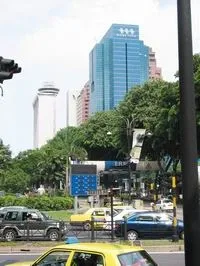
Singapore introduces ban on smoking in public places
Singapore's new anti-tobacco legislation bans smoking in clubs, bars, cafes and restaurants, as well as in karaoke centers popular in Southeast Asia, RIA Novosti reports. The initiative of the country's authorities, aimed at protecting the rights of the non-smoking part of the city-state's population, will be introduced everywhere within the next two years.
"Citizens who do not have this harmful habit will now be able to enjoy their favorite dishes in city restaurants and cafes without fear of risking their health through so-called passive smoking," said Singapore's Minister for Environment and Water Resources, Dr. Yaacob Ibrahim.
However, according to him, the number of smokers in Singapore is so significant that the authorities have to allow owners of entertainment establishments to equip a special room where those who wish can smoke a cigarette without harming other visitors.
According to the minister, the results of a social survey conducted before the adoption of the new law indicate support for the government's measures to promote a healthy lifestyle from both restaurant and club owners and smokers themselves.
"Smokers have understood the need to protect their fellow citizens from the inevitable inhalation of tobacco smoke in crowded places, especially in small rooms. A similar reaction came from the owners of entertainment establishments," said Ibrahim.
Earlier, the Singapore government banned the sale of chewing gum in the country, except for anti-nicotine gum, in order to maintain cleanliness in public places.
Lufthansa to use fingerprint tickets
German airline Lufthansa has become the first airline to introduce biometric technology into tickets. According to Travel.ru, the company has begun testing a new passenger check-in system that works with tickets containing a coded thumbprint. The two-week trial period began on Monday with Lufthansa employees getting familiar with the system. If all goes well, the airline expects to fully deploy the system in 2006.
The company hopes to increase the capacity of ticket control points without compromising security requirements. According to Yaknou, passengers will still be able to go through "classic" pre-flight check-in, but voluntarily agreeing to use biometric tickets will speed up the process. In this case, passengers will be issued tickets with a coded thumbprint. During check-in, it will be enough to place a thumb on a special device. Frequent flyers will receive passes with a fingerprint instead of regular tickets.
State Department warns Americans of dangers when leaving the US
The US State Department has issued a statement in which American citizens are effectively advised not to leave the country. As noted in the document, according to operational information, the terrorist group Al-Qaeda and organizations cooperating with it continue to plan terrorist attacks in "many regions", including Europe, Asia, Africa and the Middle East.
Planned operations against US citizens include murder, kidnapping, hijacking of aircraft and bombings. Attackers may use both conventional and nuclear weapons, and the target may be both official US interests and the private lives of Americans.
All American citizens abroad are urged to be even more vigilant, stay informed of local news and maintain contact with US embassies and consulates.
According to Lenta.ru, danger may await Americans in residential areas populated by foreigners, business centers, clubs, restaurants, places of worship, educational institutions, hotels and other public places. In addition, the State Department warns, public transport, civil aviation and water transport are also vulnerable to terrorists.
Belgium to fine swimmers on wild beaches
In Belgium, fines will be imposed for swimming in prohibited areas on the North Sea coast. As local media reported, according to RIA Novosti, "wild" swimmers will be fined starting next summer.
This duty will be assigned to lifeguards, who will now have to complete special courses at the police. The size of the fines will be determined by local authorities. However, it is already known that in a number of resort areas they will be €250.
This summer, the Belgian coast of the North Sea saw an increase in the number of emergencies related to swimming on wild beaches.
Turkey has become an international center of prostitution
Turkey has become an international center of prostitution. Over ten years, more than 30,000 representatives of the oldest profession have been deported from the country, according to the Turkish General Directorate of Security.
A significant part of the prostitutes, the newspaper Radikal reports citing a police report, are women from CIS countries. In the last five years alone, 2,300 prostitutes, mostly from former Soviet republics, have been detained in the Black Sea city of Trabzon.
In the last two years, Turkey has intensified cooperation with international organizations to combat criminal groups involved in human trafficking and the "export of prostitution." Thanks to the measures taken, 365 women have been rescued from the "sexual swamp," including 60 citizens of Ukraine, 71 of Russia, and 91 of Moldova.
To help women who have become victims of human trafficking, a hotline began operating in Turkey this year. Advice from qualified specialists, including in Russian, can be obtained by calling the toll-free number 157. Special stands installed at all international airports of Turkey inform about the hotline.
Americans are concerned about the negative image of the US in the world
Most Americans are concerned about the negative image of the US in the world. As RIA Novosti reports, this is evidenced by the results of a public opinion poll published in Washington, conducted in the US by order of Foreign Affairs magazine and the public organization Public Agenda with the support of the Ford Foundation.
The study showed that, according to 65% of Americans, attitudes toward the US abroad are negative. Only 15% of respondents believe that the image of their country is positive, and 14% think that the world views the United States neutrally.
Respondents were asked to specify how, in their opinion, residents of other countries characterize or call America. The characteristic "negative" was given by 18% of respondents, "bully" - 11%, "aggressive" - 8%, "materialistic and spoiled" - 6%, "strong" - 6%, "arrogant" - 5%. According to 4% of Americans, their country is envied abroad.
Only 3% of respondents are sure that America is considered "rich" abroad, and another 3% believe that the world characterizes the US as a "free and democratic" country.
The poll also showed that Americans rank the "negative image in the eyes of foreign states" third after the war in Iraq and the threat of terrorism among America's main problems.
Answering a question about US relations with other countries of the world, a majority of Americans (49%) admitted that in the actions of the United States, "too much worries and disappoints them". According to 40% of respondents, the US abroad "does, on the whole, the right things".
The authors of the study also asked respondents to express their attitude to a number of critical statements about America often heard abroad. 55% of Americans agreed with the statement that "the US cares only about its own interests and ignores the interests of other countries." At the same time, 19% consider this statement completely fair, and 36% consider it "partly fair". According to 44% of respondents, such a characterization of the US is unfair.