
Slovakia to switch to euro from January 2009
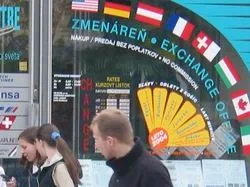
Slovakia will switch to settlements in euros from January 1, 2009. According to ITAR-TASS, this deadline for Slovakia's entry into the single European currency zone was set by the republic's government on the recommendation of the Finance Ministry.
During the first 16 days, the Slovak koruna will continue to circulate alongside the single European currency in Slovakia. Commercial banks operating in the country are required, from January 1, 2009, to convert accounts in Slovak korunas to euros and make payments exclusively in this currency.
Independent Bratislava economists predict the possibility of a serious decline in the real incomes of the population of economically significantly weaker Slovakia compared with Western European countries after the transition to the euro.
Luxembourg voted for the European Constitution
Residents of Luxembourg approved the European Constitution in a nationwide referendum last Sunday. According to CNN, preliminary data show that 56.52% of the country's citizens voted for the adoption of the document, and 43.48% voted against.
A total of about 230,000 people took part in the voting, that is, the entire population of the country. As Lenta.ru notes, this is because failure to vote in Luxembourg is punishable by a large fine.
It should be recalled that earlier the Prime Minister of Luxembourg, Jean-Claude Juncker, stated that the results of the vote in that country would be decisive for the constitution, which had already been rejected by residents of France and the Netherlands. In Luxembourg, the referendum results are advisory in nature, but the country's parliament has already stated that it will take into account the opinion of the majority.
After the failure in France and the Netherlands, the heads of the EU member states decided to suspend the ratification process of the constitution in Europe, but Luxembourg nevertheless decided to hold the referendum.
US abolishes all visa fees for Ukrainians
To further facilitate travel between Ukraine and the United States, the US has abolished all types of fees for nonimmigrant visas for Ukrainians. This was reported by the US Embassy in Ukraine.
Ukrainians applying for nonimmigrant visas will pay only the visa fee approved by Congress in the amount of $100, mandatory for all those applying for an American visa in any country of the world.
As the embassy press service notes, this is one of the many steps taken by the United States to improve consular services provided in Ukraine. So, every Wednesday from 14:00 to 15:00, travelers who have confirmed data about recent trips to the US have the right to apply for a nonimmigrant visa without prior appointment.
This spring, the US Embassy in Ukraine issued a record number of visas for exchange program participants. About 3,000 Ukrainian students will take part in this summer's Work and Travel programs, which involve work and travel in the United States.
Ukraine extends visa-free regime for the EU
Ukraine will indefinitely extend the visa-free regime for citizens of European Union countries and Switzerland. This was announced by Deputy State Secretary of Ukraine Markiyan Lubkivsky.
As Interfax-Ukraine reports, the deputy state secretary recalled that under a decree of the President of Ukraine, the visa regime for citizens of EU countries and Switzerland was canceled from May 1 to September 1, and from July 1 a visa-free regime was introduced for US citizens.
France to speed up transition to biometric visas
As part of measures to counter terrorism taken in connection with the series of explosions in London, France has decided to speed up the transition to biometric visas. This was stated at a press conference by the head of the republic's Foreign Ministry, Philippe Douste-Blazy.
As RIA Novosti reports, the minister recalled that at present an experiment on issuing biometric visas is already being conducted at several French consulates abroad, and equipment for "reading" new documents has been installed at Paris airports "Roissy" and "Orly", as well as at the Marseille port. "This experiment proved successful, and the events in London prompted us, in coordination with the Interior Ministry, to speed up the transition to biometric visas," said the head of the Foreign Ministry.
According to him, in 2006 biometric visas will begin to be issued at French consulates in 20 foreign countries, the list of which should be agreed upon in the near future between the Foreign Ministry and the Interior Ministry. By the end of 2007, new-style visas will be issued at all 210 French consulates abroad.
Douste-Blazy said that currently a biometric visa includes fingerprints of both hands and a digital photograph, and in the near future it should be supplemented by one more element containing information about the retina. The head of the Foreign Ministry did not directly say that the introduction of biometric visas would entail an increase in the cost of visa services, but he noted that due to the costs of new equipment, "the ministry will be faced with the task of increasing revenues from the issuance of visas."
The minister stressed that the transition to biometric visas will make it possible to more thoroughly control the entry and especially the exit of foreigners arriving in France, and thereby help more successfully combat terrorism, illegal immigration, and human trafficking.
In Saudi Arabia, tourists will be allowed to take photos and videos
In Saudi Arabia, photo and video shooting in public places will be allowed. Such a truly revolutionary decision for the conservative kingdom was made by the Supreme Commission for Tourism.
As the commission's secretary general, Prince Sultan ibn Salman, told local journalists, the decision will take effect in 10 months. "The decision does not apply to filming important civilian, military, and industrial facilities," he stressed, adding that special bodies will be created to monitor strict compliance with the ban.
First of all, reports Turist.ru, historical and archaeological sites as well as museums visited by foreign tourists will be open for filming. In other countries of the Arabian Peninsula, foreign tourists can photograph local men only with their permission, and taking pictures of women is completely prohibited.
Lufthansa to use fingerprinting at check-in
Approximately 400 Lufthansa employees at Frankfurt Airport have begun testing the Trusted Traveller passenger check-in and boarding system based on fingerprint verification.
The German airline took this step in an effort to speed up passenger service and increase transport security. The technical side of the project was implemented in cooperation with Siemens.
In the second phase of the Trusted Traveller project, which will begin in 2006, the system will be introduced into a real service line and will cover a second airport, initially limited to frequent flyers. The project organizers emphasize that the use of the system is voluntary.
The system works as follows: passengers undergo fingerprint scanning when checking in baggage. Fingerprints are stored in a database. Along with registration information, the fingerprint is printed in encrypted form (as a barcode) on the boarding pass. During boarding, the code on the pass is verified against the actual fingerprint. If the data matches, the passenger is allowed on board the aircraft. As Travel.ru reports, biometric control procedures in air transport are currently performed on a voluntary basis, but may become mandatory in the future if a relevant EU directive is adopted.