
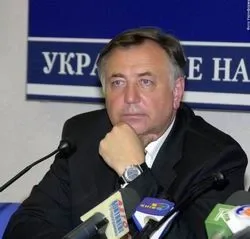
Valery Tsybukh sent to Greece
Valery Tsybukh has been dismissed from the post of head of the State Tourism Administration of Ukraine. According to Interfax-Ukraine, this is determined by a decree of the President of Ukraine dated June 29. By another decree, the president appointed Tsybukh as Ukraine's ambassador to Greece.
In April, the Ministry of Culture and Arts of Ukraine was reformed into the Ministry of Culture and Tourism. Until recently, the central executive body dealing with tourism issues was the State Tourism Administration, equal in status to a state committee. Valery Tsybukh had headed it since January 2002.
German opposition defends labor market
Representatives of the German opposition are trying to prevent the influx of unskilled labor into the European labor market, particularly from Ukraine, reports Deutsche Welle.
On the agenda of the Bundestag's internal affairs committee is the so-called "European Green Paper on Economic Migration." The point of this document is to solve the demographic problems of the European population by increasing the number of foreigners.
Meanwhile, representatives of the conservative factions CDU/CSU, Hartmut Koschyk and MP Reinhard Grindel, believe that the new rules will not solve the problems of Europeans. On the contrary, they could lead to a massive migration of labor from non-EU countries. In their opinion, the European Commission's proposal contradicts German law, according to which only highly qualified specialists can apply for a job in Germany and thus also for a residence permit.
Opposition deputies demand a review of the procedure under which mostly Ukrainian illegal immigrants received passports in Spain and Portugal. According to the deputies' estimates, 750,000 former refugees were thus put on an equal footing with Europeans, and they can now come to Germany.
Britain to introduce passports and ID cards
Britain intends to combine the issuance of biometric passports with the introduction of internal identity cards. As RIA Novosti reports, British Prime Minister Tony Blair announced this at his monthly press conference at his Downing Street residence.
A bill on the introduction of personal identification cards with biometric data is currently going through its second reading in the British House of Commons.
The British prime minister recalled that the introduction of biometric passports was provided for by previously reached international agreements. "By 2006, the G8 countries should start doing this; this year Australia and New Zealand are introducing such passports; the EU countries intend to include biometric information in passports from mid-2006, and fingerprints from mid-2008," Blair said.
According to him, from October 2006 the United States will stop letting British tourists without visas into the country unless they have biometric documents. "Four million Britons visit the United States every year, and we cannot subject them to the need to obtain a tourist visa and pay £60 for it," Blair stressed.
He also noted that "the public supports the introduction of biometric documents as a measure to combat illegal migration and the illegal movement of labor." "We must make our passports biometric so that we can travel freely," Tony Blair said.
At the same time, according to the head of the British government, a "unique situation" has now arisen in which, along with the production of new passports, there is an opportunity to simultaneously produce personal identification cards, saving significant amounts of money.
The question of introducing internal identity cards in the form of cards with information about a person and his biometric data (iris pattern and fingerprints) has been discussed in Britain for several years. According to some estimates, implementing this scheme will cost £18 billion.
Latvia temporarily cancels visa fees for Ukrainians
From July 1 to August 31, Ukrainian citizens, by decision of the Latvian government, will receive Latvian visas free of charge, reports Interfax. The director of the consular department of the Foreign Ministry, Uvis Blums, said at a government meeting that Ukraine had abolished the visa regime for citizens of EU countries until August 31, and many of them had already responded by reducing or completely eliminating fees for their visas for Ukrainians.
Despite the fact that this decision will result in the Latvian state budget losing 45,000 lats, the Latvian Foreign Ministry believes that this should be done to facilitate the free movement of people across Europe. The consular department of the Latvian embassy in Ukraine reported that from July 1 the Republic of Latvia has abolished fees for single-entry and transit visas for Ukrainians. "For Ukrainian citizens, single-entry and transit visas will be free temporarily," explained a representative of the Latvian embassy. "For now until August 31," the consular department clarified.
As reported, on March 31 the President of Ukraine signed a decree according to which citizens of the European Union and Switzerland can stay in Ukraine without visas for up to 90 days in the period from May 1 to September 1, 2005. At the same time, during the trial period of the visa-free regime introduced unilaterally by Ukraine, a thorough analysis of all its aspects will be carried out with the aim of further liberalizing the regime of mutual travel of citizens. At the same time, the visa-free entry procedure will not apply to persons who travel to Ukraine for employment and study, as well as for migration purposes from EU countries.
Ukraine to let Americans in without visas
President of Ukraine Viktor Yushchenko signed a decree "On establishing a visa-free regime for U.S. citizens." As reported by the presidential press service, from July 1, 2005, a visa-free regime is established for entry into Ukraine and transit through its territory for U.S. citizens, if they re-visit Ukraine within six months from the date of the previous visit for a period not exceeding 90 days.
The decree, the press service noted, was issued with the aim of "developing and practically implementing the principles of strategic partnership between Ukraine and the United States, as well as guided by the desire to simplify the regime of mutual travel of citizens and intensify bilateral contacts in all spheres of relations."
Germany's population decreased by 31,000 people in a year
Germany's population as of December 31, 2004, numbered over 82 million 501 thousand people, which is 31 thousand less than a year earlier. As RIA Novosti reports, these are data published by the Federal Statistical Office.
Last year, mortality exceeded births by 113 thousand people, and this deficit could not be compensated for by the inflow of foreigners and the return of German citizens to their homeland. The trend of mortality exceeding births has been observed in Germany since 1991.
Italy's population increased by half a million people
Italy's population in 2004 increased by more than half a million people. As RIA Novosti reports, this was announced by the ANSA agency, citing the National Institute of Statistics.
The calculation was made based on data as of December 31, 2004. Before this, no population growth had been observed in Italy for the last 12 years. Currently, 58 million 462 thousand 375 people live on the Apennines.
The U.S. will tag tourists with radio frequency tags
Tourist visas to the United States will be fitted with radio frequency identification tags (RFID tags). The program officially starts on August 1, said Jim Williams, director of the immigration and tourism department.
Under the program, passive RFID chips will be placed in tourist visas of foreigners arriving in the United States, allowing multiple rewrites. The introduction of this technology will strengthen control over the movements of foreigners, and if necessary, will make it possible to count the number of tourists leaving the country without having to stop them for document inspection.
The experiment will last until March 2006, reports PROext. Similar RFID chips will be built into documents issued by the five largest U.S. airports. If the technology is approved by the government, after the test period similar tags will be applied at all other customs points in the country.
Ecuador will send 500,000 illegal immigrants to Colombia
Ecuador's foreign minister Antonio Parra said that about 500,000 illegal immigrants who arrived from Colombia could soon be sent home, reports Gazeta.ru.
"More than a million Ecuadorians left the country due to lack of work, but we received 500 thousand Colombians. I love Colombia and Colombians, but national interest comes first," he emphasized.
EU countries introduce 15% tax on bank deposits
In the European Union countries, a 15 percent tax on bank deposits is introduced from July 1 of this year. As RIA Novosti reports, this is provided for by an EU directive approved in its final version in Luxembourg by the Council of Ministers of Economy and Finance of the EU states.
The directive also applies to five countries associated with the EU - Andorra, Monaco, Liechtenstein, Switzerland, and San Marino, as well as to ten dependent territories (the Isle of Man, the Channel Islands, etc.) and foreign citizens holding savings in European banks. According to the directive, from 2008 the tax on bank deposits will be increased to 20%, and after 2011 - to 35%.
Greeks work more than anyone in Europe
Residents of Greece work the most in the European Union. This is evidenced by data from the Eurostat statistical office, RIA Novosti reports.
According to statistics, Greeks spend on average 44.1 hours a week at work, including overtime and part-time work. Czechs work one hour less every week (43.1 hours), Austrians slightly less (42.9) and Poles (42.7). Cypriots close the top five of the most hardworking Europeans with 42.6 hours of work per week.
The average number of hours spent at work for the European Union countries is 40.9 hours.
Low-cost German airlines are forced to raise fares
The head of Germany's largest budget airline Air Berlin, Joachim Hunold, believes that an increase in prices for cheap airline tickets is inevitable.
According to Hunold, who spoke in the specialized consumer magazine Guter Rat, all possibilities for saving money have already been exhausted. The reason is the continued rise in energy prices. By the way, it was this airline, following the example of German railway workers, that last week sold its tickets by selling special certificates in a discount supermarket, reports Deutsche Welle.