
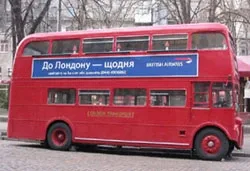
Foggy Albion is much closer
A real London double-decker bus has "parked" on Horodetskoho Street in Kyiv until the end of May. By organizing such an unusual display, British Airways decided to remind everyone that Foggy Albion is much closer than it seems. Anyone who takes a photo near the double-decker and brings it to the airline's office by May 31 will receive a special discount on a ticket between Kyiv and London. Thus, traveling with British Airways to the capital of Great Britain will become not only pleasant and convenient, but also even more affordable.
In 2005, Kyiv will make 12,000 foreigners Ukrainians
The Ukrainian government has set an immigration quota for the country. According to the news agency Novosti-Ukraina, the total quota is 12,022 people.
Of these, Ukraine can accept 4,950 people who are brothers, sisters, grandfathers, grandmothers, grandsons or granddaughters of Ukrainian citizens; 772 immigrants who previously held Ukrainian citizenship; 5,305 people who are parents, spouses of an immigrant and his or her minor children; 971 people who have lived in Ukraine for three years after receiving refugee status in Ukraine, as well as their parents, spouses and minor children living with them. In addition, the country is ready to accept 24 immigrants who have invested at least $100,000 in its economy and registered that investment with government agencies.
The current quota is more than three thousand less than last year, when the government counted 15,130 immigrants, and almost half the figures of 2003. In the year before last, the quota was 23,890 people.
Billions spent on airport security in vain
More than 3.5 years after the terrorist attack in New York, the effectiveness of U.S. Transportation Security Administration staff at airports remains at the same level as in 2001. According to the Associated Press, this is stated in reports that the Government Accountability Office and the U.S. Department of Homeland Security are preparing to release.
The main points of the reports were outlined by members of the House of Representatives' aviation subcommittee. In particular, subcommittee chairman John Mica believes that "many people will be shocked by how many billions of dollars were spent on enhancing security measures and what the result is."
Another subcommittee member, Peter DeFazio, said the reports differ in their comparative assessments of the work of TSA employees and private security guards. However, overall, he said, the results of the reviews indicate that neither government nor private security guards can ensure an adequate level of security.
DeFazio specifically criticized the X-ray machines used to inspect baggage at American airports. According to him, the Capitol and the White House have long been using far more effective technologies.
Meanwhile, a TSA spokesman stressed in turn that "when the political games end, rational people will see that our security guards are now better than ever, and that their capabilities are limited only by existing technologies and restrictions imposed by the need to protect privacy." He also noted that requirements for security personnel are now much higher than before autumn 2001.
France plans to switch to new biometric documents only in five years
In five years, France will have to switch to new identity documents containing biometric data, and French citizens will have to pay for the production of these documents out of their own pockets. According to RIA Novosti, this was announced by the country's Interior Minister Dominique de Villepin.
In an interview with the newspaper France-Soir, he said that the head of government had recently approved a draft prepared by the Interior Ministry for new national identity cards and foreign passports with an electronic chip that would contain the document holder's biometric data. These are fingerprints and a digital photograph, which will make it possible to establish identity without error, the minister explained. He did not rule out that "in the future, a third identification element may be added to the documents, namely the iris of the eye."
According to the minister, various categories of temporary residence permits, on the basis of which numerous foreigners are in France, should also contain the biometric data of their holders. Documents with biometric elements are "a key bet in ensuring the security of French territory and its citizens," the interior minister stressed. "For this system to become truly effective, the identity card must be made compulsory," the minister said.
The interior minister plans to make the transition to the new documents "within a short period of about five years." According to the minister, France has the necessary industrial and technological conditions to accomplish this task within that timeframe. According to the interior minister, implementing the plan to introduce the new documents will cost the treasury €205 million annually, so the new biometric identity card will be paid.
Budget airlines caused a boom in traffic in Eastern Europe
The European Airports Association has summarized the performance of major airports in Eastern European countries that joined the European Union in 2004. All of them showed significant traffic growth. According to Travel.ru, the first place among "newcomers" was taken by Prague Airport - 9.7 million passengers (a 30% year-on-year increase).
In second place is Budapest - 6.4 million passengers (growth 29%), in third place is Warsaw - 6.1 million (18%). Riga airport served 1.06 million people (growth 49%), Ljubljana - 1.04 million (12%), Tallinn - 1.0 million (38%), Bratislava - 894 thousand (86%), Krakow - 841 thousand (43%), Gdansk - 467 thousand (28%), Wroclaw - 363 thousand (28%). Such a powerful increase in passenger traffic through these airports was caused, among other things, by the strong entry of low-cost carriers into Eastern European routes. In addition to budget companies from Western Europe, the new EU countries have also created their own. Among them are SkyEurope (Slovakia), Wizz Air (Hungary), Smart Wings (Czech Republic) and Centralwings (Poland).
The lowest incomes among EU countries are in Latvia and Lithuania
In the 15 states of the former EU, wages are four times higher than the labor incomes of citizens of the ten new member countries of this regional organization. As RIA Novosti reports, this is evidenced by the results of a study conducted by the British consulting company Mercer Human Resource Consulting.
According to the study, in terms of euros, the highest nominal average salary among the current EU countries is in Belgium (€53,577 per year), in Sweden (€52,800) and Germany (€50,445). By this indicator, the top five also included Luxembourg (€49,752) and the United Kingdom (€46,541). On the contrary, the lowest labor incomes among EU countries are in Latvia (€4,752) and Lithuania (€5,649).
As the study results showed, overall across the 25 EU countries, the average nominal salary is €28,269 per year. At the same time, in Western European countries, salaries are on average 23% higher than in the USA, and in Central and Eastern Europe they are 15% lower.
Among EU states, the highest income taxes are set in Greece, Belgium and France, the lowest in Denmark, the Netherlands, the United Kingdom and Luxembourg.
Forced marriages banned in Saudi Arabia
The religious authorities of Saudi Arabia have forbidden giving women in marriage against their will, CNN reports. Grand Mufti Sheikh Abdul-Aziz bin Al al-Sheikh stated that a father attempting to "make his daughter happy" in this way will be imprisoned until he changes his decision.
According to the ruling of the council of muftis, forced marriages are "unjust" and do not conform to the norms of Islam, and "forcing a woman to marry someone she does not like, and forbidding her from marrying the one she has chosen, is unacceptable."
Meanwhile, at present, female residents of Saudi Arabia mostly marry those chosen by their families. Moreover, about half of marriages end in divorce. In addition, women in this Sharia country have a lot of restrictions. In particular, they are deprived of the right to vote, must wear clothing that covers the face and body, cannot drive a car or travel alone. Until 2001, only men had identity cards. However, recently the authorities of the absolute monarchy have been undertaking a number of reforms aimed at expanding the rights and freedoms of women.
Full smoking ban takes effect in Malta
In Malta, a ban on tobacco smoking in public places has come into full force. As Turist.ru reports, smoking is now allowed in those bars and restaurants that have provided special exhaust equipment in an enclosed area for smoking visitors.
Let us recall that the smoking ban law partially came into force in October last year, but at that time it applied only to establishments with an area of over 60 square meters; now it applies to any catering establishments. The population is officially allowed to anonymously report the owners of those establishments where people smoke in violation of the law; the police will carefully check the received reports.
Interestingly, the new rules were supported by 75% of smoking Maltese and 95% of non-smokers. Of course, cafe and restaurant owners were against it, as the ban will repel many visitors. Pub owners are also not happy, as their atmosphere is traditionally associated with thick cigarette smoke - they will definitely lose regular customers.