
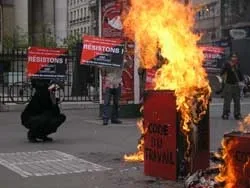
According to the French Ministry of Education, the protest movement against the labor law reform has engulfed nearly three-quarters of the country's universities, and the activities of many higher education institutions are almost completely paralyzed due to the student strike. Meanwhile, judging by various testimonies, the student movement is far from homogeneous and all-encompassing. There are many among students who would not like to interrupt the educational process, regardless of whether they support the "first employment contract" or oppose it.
Over the past week and a half, rallies of students demanding order in universities and resumption of classes have been held twice in Paris. However, their voices are less audible compared to those who call for striking and continuing demonstrations.
As told by a student of one of the Parisian universities, who called herself Sophie, in her institution meetings were held three times to decide on the strike. At the first such meeting, a majority decided not to interrupt the educational process, but the very next day those who had been in the minority the day before held a second meeting and voted for a strike. And when, according to Sophie, other students nevertheless tried to go to classes, the strikers set up pickets of "guards" armed with sticks and iron bars at the university entrance, and also called on students from neighboring lycées for help.
On the eve of the third meeting, Sophie recounted, students opposing the strike were subjected to threats and intimidation, and even at the meeting itself some young people with wrapped faces freely walked around the hall, exuding aggression with all their appearance. Because of this, many students were afraid to come to the decisive meeting, while the rebels brought "reinforcements" in the form of "daredevils" from other universities.
The opportunity to speak at the meeting, according to the student, was given almost exclusively to supporters of the strike, who often spoke off-topic and claimed, for example, that the "first employment contract" makes it easier to fire pregnant women or allows dismissing those who dress "inappropriately" outside working hours.
Nevertheless, when it came to voting, according to Sophie, only about a third of the meeting participants spoke in favor of the strike. Nevertheless, it was announced that "they" had won. The student, who talked about the nuances of the strike's "backstage," expressed regret that the undemocratic methods of supporters of the student strike do not receive proper coverage in the press, which, according to Sophie, has taken a noticeably one-sided position.
Andrei NIZAMUTDINOV.
RIA Novosti