
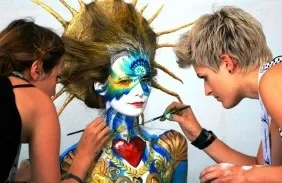
According to the World Tourism Organization, of the 715 million people who make international trips annually, 4 million visit Austria - mainly in April-September. About 40% of foreigners prefer to stay in four- and five-star hotels. It is in spring, summer and early autumn that the peak of festivals occurs, which, as a rule, are held in open-air venues. A significant part of foreign tourists go to Austria precisely for the purpose of having fun, participating in various artistic, musical and gastronomic festivals and carnivals.
Multifaceted Vienna
"Art and enjoyment" - that is exactly how the motto of the capital of Austria sounds this year. Two years ago, the Museumsquartier opened in Vienna, which has become a popular place of recreation for both Austrians and Europeans. This year, one of the museums in the quarter - the Leopold Museum - will host an exhibition of 350 graphic works by the French post-impressionist Toulouse-Lautrec (April-August). The theme is sketches of the frivolous life of Parisian Montmartre captured in painting. Along the way, you can admire paintings by famous masters - from Klimt to Waldmüller.
In 2003, a significant event in the cultural life of the capital already took place. On March 14, after an eight-year reconstruction, the Albertina opened in the city center - the world's largest collection of graphic art (65,000 drawings and a million printed images). As is known, the founder of the collection, who gave the museum its name, was Duke Albert von Sachsen-Teschen. Together with his wife Maria Christina, he spent 50 years collecting works of graphic art. The opening of the museum was marked by a unique exhibition of the Norwegian expressionist Edvard Munch, whose work is presented here with two thousand works (the exhibition will run until June 22). In March-June, the Belvedere Gallery will display an exhibition of the famous Austrian artist of the 19th century, Friedrich von Amerling (80 paintings presented).
And in the imperial palace Hofburg, the private chambers of Empress Sisi have already been opened - the restored large salon, the porcelain-lined dressing room, as well as the gymnasium, where the rings on which Sisi trained daily to maintain her wasp waist have been preserved. In October of this year, the musical "Elisabeth" will resume at the Theater an der Wien - a fascinating and romantic story of the beloved Empress Sisi.
From the beginning of May until June 16, City Hall Square will become the venue for the Vienna Festival Weeks. The planned 184 performances will present 35 productions from 12 countries of the world. For music lovers, a large European party is planned on Danube Island (June 19-22) with the participation of first-rate pop and rock stars.
Musical Salzburg
The musical spring in the city has already been opened by the Easter Festival, which features the Berlin Philharmonic Orchestra. It is followed by the Salzburg Whitsun Festival (June 6-8), dedicated to baroque music. Works by Handel, Vivaldi, Bach, Corelli and others will be performed here. The works will be performed by musicians of the Berlin Academy of Early Music and the Vienna Academy.
Salzburg's summer stage (late June - mid-July) will be devoted to contemporary dance. At its opening, the world-famous Canadian group Lalala Human Steps will perform.
And at the most famous Salzburg Festival (from July 26 to August 31), viewers will see a sea of performances - 188 in total. At its opening, Mozart's opera "The Abduction from the Seraglio" will be performed. The premiere of H. Henze's opera "Utopia and Triumph of Filial Love" promises to be the culmination of the festival.
Year-round, concerts under the working title "Classical and Romantic Chamber Music" will be held in Mirabell Palace and the Mozart Museum House. The palace interiors will be a beautiful frame for miraculous music.
Graz: A Cultural Get-Together of European Level
This cultural event in the life of the countries of the Old World is held annually in one of the most popular tourist centers. Millions of Europeans who worship the eight ancient Greek muses - Calliope, Clio, Melpomene, Polyhymnia, Thalia, Terpsichore, Erato and Euterpe - choose from the hundreds of cultural events offered within the framework of the European Art Festival several, but the most striking, fascinating and informative ones. The festival is designed for the taste of a refined, sophisticated audience.
What is the uniqueness of the festival? First, presenting to the general public the cultural achievements and attractions of a particular city, region, or country over the calendar year. Second, the most devoted art lovers can attend concerts of famous artists, pop and jazz groups, art exhibitions, theater and film festivals, as well as meet continental celebrities, take part in street processions and musical lotteries. As a rule, the peak of European art festivals occurs in summer-autumn. It is during this period that cultural fun moves from closed venues to the street. The fun lasts all night.
In 2003, the capital of the European Art Festival became Graz, which has a population of a quarter of a million people. The capital of Styria is cozy and green, moderately provincial and avant-garde. The city has its own history and culture, three universities and many open-air venues for entertainment events.
Of course, holding such a cultural event in Austria (the city is located two hours' drive from Vienna) should attract the attention of our compatriots as well. After all, it is easier and cheaper to get to Austria than to Spain and Belgium. Note that UNESCO has included the old part of Graz in the list of European cultural heritage monuments. Admirers of musical and fine arts, as well as connoisseurs of medieval architecture, dream of getting here.
And the history of Graz begins about 900 years ago. In the Middle Ages, the city was a brilliant residence of the ruling Habsburg dynasty. To this day, the city has preserved many romantic places: hidden courtyards and Renaissance-style buildings. The capital of Styria has many attractions. Above the red roof tiles of the houses, the Green Mountain Schlossberg rises over the city, like the Acropolis over Athens. Once there was a fortress, but almost nothing remains of the massive walls. The remains of the fortress are used as an open-air stage. The Clock Tower, a symbol of the city, also rises there; the heart of Graz has been beating here since 1712. And near the tower is a bell installed in 1382.
In Graz there are also buildings from the Italian Renaissance with medieval houses and courtyards - masterpieces by the 16th-century architect Domenico dell'Allio. Today, the historic buildings in the Landhaus quarter serve as a beautiful backdrop for open-air concerts and performances. And next to the Landhaus is the Arsenal. Since 1551, the Armory has housed one of the largest collections of historical weapons in the world (30,000 exhibits).
Gothic style in Graz is represented by the cathedral, built by Emperor Frederick II in 1438 as a city and court church. At the beginning of the 17th century, architect Pietro de Pomis built the Mausoleum, which together with the Burg (here is the residence of the government of the province of Styria), the Theater, and the Jesuit University form the "city crown of Graz". The Burg, or fortress, is famous for its double spiral staircase (built in 1499). And the construction of the modernist Opera building involved renowned European masters - Fellner and Helmer.
Not far from the Opera House is the Town Hall, in the center of which a fountain of Archduke Johann was placed as a memory of the Styrian prince - founder of the Joanneum Museum, from which the Technical University later grew.
It is in this city that many cultural events are already taking place within the medieval, Renaissance, and Baroque quarters as part of the European Year of Culture.
Throughout the year, many cultural events will take place on the island on the Mur River (an original island that looks like two halves of a mussel shell floating down the river, created by American architect Vito Acconci). From April to September, the "Phantom of Happiness" campaign is planned, combining two main events: the exhibition "Venus in Furs" (masochistic visions in art) and a series of avant-garde events "MasoMania. Rhetoric and Scenarios".
In summer, an open-air classical music festival "Classics in the City" will take place (admission will be free). At the beginning of summer, the Kirov Opera Theater from St. Petersburg promised to come. In August, a series of concerts by young musicians from around the world is planned - presenting well-known musical masterpieces in a new interpretation, as well as a jazz music festival.
Autumn is the busiest season. In mid-September, the Brahms Music Festival will take place. From October 24 to November 24, the contemporary art festival "Styrian Autumn" will be held, in which musicians, directors, designers, artists, and performers will participate. In mid-October, Graz will welcome pilgrims from all over the world, and from November 14 to 16, the International Mountain Climbing Film Festival will take place. And the European culture festival in Graz will end with Christmas celebrations. A pleasant moment for Ukrainians is the "freebie" of many organized events.