
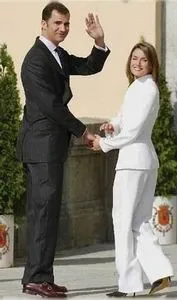
In Madrid and other European capitals, rumors occasionally arose about the prince's imminent marriage. Thus, back in the early 1990s, the royal court was forced to publicly deny speculation that Don Felipe's chosen one was supposedly Isabel Sartorius, the daughter of a Spanish marquis and an Argentine woman.
However, King Juan Carlos I and Queen Sofia supposedly considered marriage to this student of international relations inappropriate because her parents were divorced. And after the wedding of his sister, Infanta Elena, there was talk of an allegedly impending engagement of Don Felipe to Princess Tatiana of Liechtenstein. However, this too was denied not only by the press service of the royal house but also by the monarchs themselves.
The die is cast
Six years ago, in an interview with Spanish television on the occasion of his 30th birthday, the prince said that he did not consider such a serious event as marriage to be a mere formality or a step in line with constitutional requirements. The future wife, in his words, did not necessarily have to come from a royal family. This statement displeased monarchists, who warned: because of the modern fashion for morganatic marriages, European royal courts are digging their own graves.
In Spain, however, the marriage to a 31-year-old TV star came as no surprise: the prince's modest lifestyle had prepared Juan Carlos I's subjects for something similar.
The heir to the throne is accustomed to traveling abroad on scheduled airliners, and few foreign passengers pay attention to the elegant young man with a laptop on his knees. His six bodyguards are usually unobtrusively scattered throughout the cabin. However, the Prince of Asturias himself is hard to miss: he is 1.97 meters tall.
He willingly took on the role of envoy and promoter of Spain, which, in his opinion, the world should know much more about than it does now, and its image should be associated not only with famous tourist centers, bullfighting, flamenco, and wines but also with serious achievements in economic development.
Don Felipe also does not forget about preparing for his future royal role. He often communicates with ordinary Spaniards. In his words, "the title of king must be confirmed every day, since Spain's constitution, if necessary, allows changing our political system."
Wedding of the new century
Much has been written about the impressive wedding ceremony in Madrid on May 14; videotaping of the wedding was conducted and broadcast on television. An estimated 1.5 billion people around the world watched it. In Spain, it has already been dubbed the "wedding of the 21st century." Whether or not that is so, this important event helped Madrid residents emerge from the shock they had been in after the bloody terrorist attacks on commuter trains on March 11, in which more than 190 people died.
Spaniards calmly accepted that the Princess of Asturias became a woman of non-aristocratic origin, and a divorcee at that (although her previous marriage had not been consecrated by the Catholic Church). They respect the heir to the crown's choice, made out of love. Moreover, marriage is a necessary condition for the continuation of the monarchy, and this institution, as regular public opinion polls show, is respected by Spanish residents more than any other branch of government, primarily for the long-term stability it ensures. Someday the Prince of Asturias will ascend the throne as Felipe VI, and Spaniards hope that he and the future queen will enjoy the same popularity and respect as the current monarchs. In the meantime, a young, well-educated couple of heirs to the throne will be beside them, for whom the unexpected challenges of the new century are more familiar.
The royal wedding took place in Spain for the first time in 98 years, and moreover under pouring rain. And as an old local proverb says, "a rainy wedding is a happy marriage." Well, time will tell if that is true.
Against tradition
The first unequal marriage of the past century that defied the age-old traditions of European royal houses is considered to be the marriage in 1900 of the heir to the throne of the Danube monarchy, Franz Ferdinand, to Countess Sophie. The couple lived in harmony and happiness for nearly a decade and a half, but in 1914 they were killed in the city of Sarajevo by a Serbian terrorist.
And 22 years later, the English King Edward VIII, inflamed with unearthly love for a twice-divorced woman, preferred to abdicate the throne but keep his lady love. However, in the second half of the last century, such a choice was no longer so stark, and morganatic marriages gradually ceased to shock crowned heads: in 1968, Norwegian Prince Harald wore down his parents with persistence and finally obtained their blessing for marriage to a merchant's daughter.
He was confidently followed by Swedish King Carl XVI Gustaf, who met the beautiful interpreter Sylvia Sommerlath during the 1972 Olympics in Munich (West Germany). This commoner—a daughter of a German and a Brazilian, brilliantly fluent in many languages—became his wife and the darling of the Swedes, and the subjects still retain this feeling for their queen to this day.
By a strange coincidence, the Olympics—this time in Sydney, Australia—became the place of a happy meeting for Danish Crown Prince Frederik and an ordinary Australian girl, Mary Donaldson. They had a lavish wedding in Copenhagen just a week before his Spanish "colleague's" marriage.
Which prince or princess will pick up this "relay baton" at the Athens Olympics?
Be that as it may, marriages of future monarchs to commoners, sometimes accompanied by scandals, have become more frequent in Europe in recent years than traditional unions of members of royal families. But this by no means dooms the monarchy as a political institution that has survived many centuries to a decline in popularity. Rather the opposite.