
12\/2\/0<\/em><\/p>
Later, Europeans spread around the world and brought carnival to almost all continents, and locals gladly adopted this tradition. Carnivals in Rio de Janeiro, Goa, Basel, and Nice — each of these grand celebrations has its own flavor and special atmosphere. We invite you to get to know the most incredible carnivals in the world and try to feel what real fun is.<\/p>
Venice: city of masquerade<\/strong><\/p>
Who among us has not dreamed of being in someone else’s skin? Shy bachelors want to become elegant seducers, reserved ladies — passionate courtesans, and “average Joes” — aristocrats with blue blood. And only in one place on Earth for several weeks such metamorphoses actually happen. Therefore, the longing for transformation draws hundreds of thousands of people once a year to the city-theater of Venice, to the unique Venetian carnival...<\/p>
The history of Venice began in the middle of the 5th century, when inhabitants of the mainland found refuge from barbarian raids on small islands. Now Venice is located on 119 islands surrounded by 150 canals, connected by 400 bridges. Just as 15 centuries ago people came here from the continent, now the native inhabitants of the city are gradually moving to the mainland suburb of Venice — Mestre. There are factories, offices, and the ordinary life of an Italian city flows. And Venice itself is gradually turning into a museum city, a spectacle for tourists. And once a year, visitors have a chance not just to be spectators of this show, but to participate in it themselves. It is enough to come to this beautiful city and hire a guide in Venice during the annual Venetian carnival.<\/p>
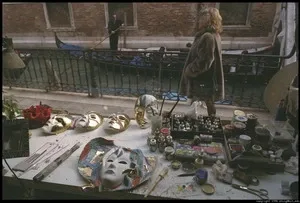
Venetians adopted carnivals along with Latin culture: the origins of this holiday, as is known, lie in the famous Roman Saturnalia. The main tradition of Saturnalia was the collapse of differences between masters and slaves. During the festivities, for example, slaves were allowed to sit at tables with their masters. However, so that class prejudices would not spoil the fun, during Saturnalia everyone hid their faces under masks. Venice became the heir to this tradition. Thus the Mask stepped onto the stage — the main character of the Venetian carnival.<\/p>
Venetian carnivals reached their peak in the 18th century. They were not only the main event of the year but also the meaning of existence. During the carnival, nothing seemed too shameful, too bold, too reckless, too dissolute. Hundreds of gambling houses opened, where huge fortunes were lost and where unknown “masks” cheated on their lawful spouses. Not to fall into sin during carnival days and nights, when even the church became less strict, was simply indecent. Then revolutions began, and the holiday was almost forgotten. For two hundred years Venice lived without carnivals, and only in 1980 did they resume.<\/p>
Now more than 500,000 romantics come here every year to merge with the festive bright crowd. Hundreds and thousands of Harlequins, Pierrots, Pantalones, and Columbines, musketeers and bautas, take to the streets, and a magnificent procession goes from St. Peter’s Palace to St. Mark’s Square, where after burning a symbolic effigy, dancing begins.<\/p>
Hundreds of people of different ages and social status take part in the procession. But they all have one thing in common — they are in costumes and masks. Moreover, if on the street you can get by with just a mask, appearing at a reception at the Palazzo without a costume is simply indecent. Sometimes invitations even specify the style and period of costumes. Some Europeans specially bring stunning outfits to the carnival, which the most skilled tailors sewed for months and which sometimes cost more than ten thousand euros. But the bulk of tourists turn into Pulcinellas and Pierrettes right in Venice, where there are many shops offering the necessary clothing and props.<\/p>
The main thing is to choose where to appear in such a luxurious outfit, and we will try to help you with that. So, in 2004, the carnival will take place from February 7 to 24. The so-called public program of this holiday is diverse and, of course, free. The public will be entertained by numerous jugglers, musicians, fakirs, masquerade balls and competitions for the best carnival costume will be held in the squares. In particular, almost every day there will be performances on Via Garibaldi, Campo San Polo, Bacino S. Marco, the Grand Canal, and St. Mark’s Square.<\/p>
However, the real carnival madness, capable of transporting guests several centuries back, will unfold at masquerade balls, social receptions, and parties in the Palazzo. Here you will have to shell out both for the entrance ticket and for an appropriate costume. You can raise a toast to the start of the carnival on the evening of the 21st at Gran Caffe Lavena or Gran Caffe Ristorante Quadri, ticket price 80 euros. By paying 350 euros for the gala dinner and masquerade ball Perle D’Oriente at the Hotel Europa & Regina, you can enter the palace of an eastern ruler with its exotic entertainment.<\/p>
And Palazzo Nani-Bernardo for 300 euros offers you to become a guest of the “Casanova Ball” and taste all the depraved and alluring pleasures of 18th-century aristocrats. On February 26, you can participate in a masquerade on the water by buying a ticket for 120 euros for a boat ride along the city canals with a subsequent dinner at the restaurant Le Poste Vecie, or under the cover of a mask and in a historical costume, dance at a masquerade ball at Palazzo Pisani-Moretta, which will cost you 380 euros. An atmosphere of eroticism, sensuality, and bliss will reign on the evening of February 28 at Palazzo Ca’ Zenobio, and the romantic spirit of Renaissance Venice will be recreated for you at the Venezia Romantica reception on March 1 at the Hotel Danieli. Both parties require historical costumes, ticket price about 400 euros. On March 2, at Palazzo Carminati, a costumed performance “Shadows of Love” will take place, which will faithfully recreate the fantastic, frivolous atmosphere of 18th-century carnivals.<\/p>
And finally, to conclude all this action, on the evening of the very last day of the carnival, at Palazzo Ca’ Zenobio, the 'Golden Night' will begin - a real ball that will make you forget that outside Venice it is the 21st century, and immerse you in a world of surprises, love and entertainment, where absolutely anything is possible.... And isn't that why we go there?
The Fifth Season in Cologne
Residents of Cologne call their carnival another, fifth season. And this is not surprising, because unlike similar holidays in other cities, which last at most two weeks, the Cologne carnival stirs up the city for at least three months.
Cologne is the fourth largest city in Germany and the oldest of all major cities in the country. Its name comes from the Latin 'colonia': 2,000 years ago, Roman legionaries founded the town of Colonia Romana here on the banks of the Rhine. Even in the Roman era, the population of Cologne was 40,000 people, and by the 11th century the city had become one of the major centers of European trade. In addition, it was a real stronghold of Christianity in Germany. From that brilliant era, Cologne has preserved the famous Cologne Cathedral, founded in 1248, and more than 12 ancient churches that create the unique appearance of the city.
The Roman founders passed on to Cologne many ancient traditions, including their famous Saturnalia. However, the unbridled pagan holiday did not fit at all with Christian dogmas, so in the Middle Ages the carnival was banned under threat of prison. Only in 1800 was the ban on holding the holiday lifted. From then on, the carnival became established in Germany, and it was only not held during World War II, when only ruins remained of the city.
Now residents of Cologne claim that their carnival is the fifth season, the most fun and carefree. Every year, up to a million tourists come here to see how the phlegmatic Germans transform, and spend two wonderful weeks in the cheerful intoxication of excellent German beer. At this time, the reins of power in Cologne are taken by mummers and painted people, and everyone except doctors and police officers participates in costume balls and street processions. Few people work during the carnival days: everyone is on the streets or in pubs.
It is absolutely pointless to appear here without carnival costumes - it's a faux pas. Residents of Cologne take this so seriously that all preparations for the carnival begin three months in advance, in November. There is also a special ceremony for this: on November 11 at 11:11 am, the so-called carnival sessions begin throughout the city. Representatives of the city's carnival communities (there is even such a thing!) gather at long tables, and to the accompaniment of performances by artists, table songs and variety acts, they devise the program of the future holiday and discuss candidates for the role of the Prince of the Carnival, to whom on the last day of the festivities the Lord Mayor will solemnly hand over the key to the town hall and all power.
However, all the most interesting things begin three months later. The carnival in Germany erupts on Altweiberfastnacht, or Women's Thursday, which this year falls on February 21. A crowd of revelers gathers on the Old Square in the morning, most of them women. Everyone waits for the decisive moment: of course, it's 11:11 am. At the signal, women in carnival costumes storm the city town hall, and this 'coup' announces the beginning of the carnival.
On Women's Thursday, women are allowed everything. They declare war on everyday life and proclaim matriarchy. And to show their absolute power, they mercilessly cut off ties from all men they meet. Moreover, on this day, women are allowed to enter any institutions so as not to miss out on female happiness. Women pin the 'trophies' to their clothes, while the stronger sex walks around with stubs on their necks. However, experienced men are fully prepared for such events and wear paper ties on this day. Women send invitations for a mug of beer to the 'defeated' men, and 'no' is not accepted on this day.
On Friday and Saturday everything is more or less quiet: the carnival is celebrated in restaurants, small taverns and pubs. On these days, carnival music plays in most establishments and discounts on drinks are in effect. Saturday is the day of the spirit procession. Anyone can dress up as a spirit or ghost and take part in these festivities. On Sunday, children celebrate: it is a day of school and children's processions.
The celebration reaches its peak on Rosenmontag, Rose Monday, this year on March 3. At 11:11 am the carnival procession starts. Officially registered carnival societies parade through the city, each carrying a funny papier-mâché figure, usually a caricature of politicians. The procession starts from Chlodwigplatz and stretches for six and a half kilometers. To get a good spot, tourists take to the streets several hours before the start of the procession, locals bring chairs and stools, and some enterprising citizens rent out windows in their apartments as observation points. Usually on Rose Monday, about one and a half million spectators gather in the center of Cologne. The culmination of the holiday is the appearance of the invariable carnival trinity - the Prince, the Maiden and the Peasant. At this moment it is especially important to sit in advantageous places, because during the procession, sweets rain down on the spectators from the carnival floats.
After the fabulous Monday comes the quiet and calm Violet Tuesday. The carnival is already coming to an end, but in the evening there will be another important event - the burning of a large straw effigy, a ritual of atonement for all sins before Lent. The carnival ends on Ash Wednesday - Aschenmittwoch. On this day, everyone draws ash crosses on each other's foreheads, and traditional fish dishes are served in the restaurants and pubs of Cologne.
Great Lent begins, and with it new worries. However, on the day when one carnival dies, the motto of the next is announced. And just as all countries await spring, in Cologne they will wait all year for the new carnival - their own, the fifth season.