
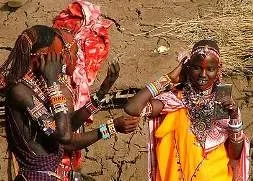
Finding a tourist 'highlight' in Africa is not difficult
In Sri Lanka, the long civil war ended this year, and a significant increase in tourism has already been noted. In May, the Liberation Tigers of Tamil Eelam were defeated, their leader was killed, and local authorities immediately launched a new advertising campaign called 'Sri Lanka – a Small Miracle' to attract as many tourists as possible. 'Its goal is to create a central idea that will help change the country's perception abroad,' says Dilip Mudadeniya, executive director of the advertising department of the Sri Lanka Ministry of Tourism. He hopes that next year the number of tourists will grow by 20% and reach half a million people. The main attraction is expected to be whale watching for blue whales and sperm whales, which pass near the southern coast of the island from December to April.
Nepal had a similar problem, where a 10-year civil war ended in late 2006. After the governments of many countries lifted travel restrictions to the country last year, the number of tourists rose to 550,000. In 2011, Nepalese hope to welcome 1 million foreign guests. Their main slogan is: 'In Nepal, there are enough places where human foot has hardly ever stepped.'
Tourists are also slowly returning to Indian Kashmir, where foreigners are attracted by the slogan 'Paradise again!' This region was once one of India's main attractions, visited by up to 700,000 tourists each year. However, after an outbreak of violence in 1989, visitors to these picturesque lands became a rarity. Lately, they have begun to return slowly. This year, more than 380,000 people visited Kashmir. The specialty here is golf, and the best club is 'Royal Springs'. The fifth hole overlooks a scenic lake and the mosques of Srinagar, and the residents of Gulmarg are proud that they have the highest golf course in the world – 2,650 meters above sea level.
Bali has recently been famous not only for its natural beauty but also, unfortunately, for the terrorist attacks of 2002 and 2005, which killed 220 people. After the first bloody incident, the number of visitors to the island, especially popular among Australians, dropped by 70%.
But perhaps the hardest hit in the region to restore its image is Pakistan. In 2007, 800,000 people came to admire the Swat Valley and the breathtaking beauty of Gilgit. In less than two years, the number of tourists exactly halved. This year, despite the government recently recapturing the Swat Valley from the Taliban, even fewer nature lovers from abroad will travel there.
Unforgettable impressions and a wealth of informative experiences can be found in other parts of Asia. For example, hunting enthusiasts can go to Phnom Penh. Not on safari, but to the Cambodian army. Enterprising businessmen in uniform offer hunters the chance to shoot any type of firearm, from ordinary pistols and machine guns to real rocket launchers. Firing into the air is not necessary. Hunters are offered a list of targets, where everyone can find something to their taste, from an ordinary chicken to a cow. For instance, shooting a cow with a rocket launcher costs $400, the shot and the target each cost $200. Credit to the Cambodian military: if the shooter misses, they refund the money for the surviving target.
However, for those who collect firearms and also love risk, the best bet is to book tickets to Somalia. On the streets of Mogadishu, according to The Economist, you can buy a grenade for $10, and a howitzer for $20,000, which you can test nearby.
The most interesting thing is that in this country, which, as expected, has a Ministry of Tourism, not a single tourist has officially visited in the last 15 years…
African countries, like Asian ones, are looking for their own 'highlights' for foreigners. The exoticism of the Black Continent itself is good, but something more special is needed. In Kenya, for example, 'slum tourism' is gaining popularity. For $35, anyone can visit Kibera – one of the largest slum districts on the planet, where hundreds of thousands of poor people live in tin and cardboard shacks.
It must be admitted that those who like to tickle their nerves do not necessarily have to go to places of recent battles or hopeless poverty. This can be done, for example, in Tokyo, where a small inconspicuous building houses the Parasite Museum. There, 300 species of parasites that live in humans are exhibited. The 'king' of the exhibition is undoubtedly a 9-meter tapeworm. It was extracted from the stomach of some poor fellow who ate poorly cooked sashimi.
Everyone has long been accustomed to races of cockroaches, frogs, and other creatures, but turtle races are still a rarity. You can watch this interesting competition on Thursdays at a bar in Santa Monica, USA.
It is not necessary, however, to travel so far. Unconventionally, with a 'highlight', you can also relax in the Old World. Near Paris there is a cemetery known among exotic lovers, where various objects, even houses and ships, are made of bones. And in the village of Ferentillo, just a couple of hours drive from Rome, you can visit the Mummy Museum. There are collected corpses that have been well preserved naturally.
Sergey LAVINOV.
Novye Izvestia