
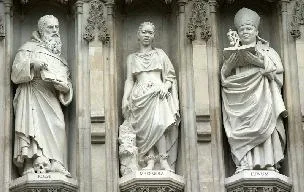
Sculptures in Westminster Abbey
Westminster Abbey
Westminster Abbey is located directly opposite the Houses of Parliament (Westminster Abbey; open Monday to Friday from 9:30 am to 3:30 pm, Wednesday until 6 pm, Saturday until 1:30 pm; admission fee).
The building in the early English Gothic style that we see today was built in the 13th century by King Henry III. This structure is a prominent landmark of London. Until 1534, the abbey maintained its role as the main monastery of the kingdom. After Henry VIII dissolved the monasteries, Westminster Abbey remained a place of coronation and burial for English monarchs. All monarchs since William the Conqueror, except for two, were crowned here.
In the south transept is Poets' Corner. The first to be buried here was Geoffrey Chaucer (1400). Behind the altar are richly decorated royal chapels and tombs. In the Tomb of the Unknown Soldier in the western part of the cathedral lies a soldier who died in France in one of the battles of World War I.
To the southwest of the abbey, near Victoria Station, stands a magnificent Roman Catholic church — Westminster Cathedral, built in the 19th century and notable for its original pseudo-Byzantine architecture (Westminster Cathedral; open Monday to Friday from 7:00 am to 7:00 pm, Saturday from 8:00 am to 7:00 pm; free admission). From the hundred-meter height of its bell tower, beautiful views of the city open up.
Tate Gallery
The Tate art gallery (Tate Britain; open from 10:00 am to 5:50 pm; free admission, except for special exhibitions) is located on the banks of the Thames, near Vauxhall Bridge, a fifteen-minute walk south of Parliament Square. Any tour to London will be marked by a visit to this world-famous London gallery. The nearest metro station is Pimlico, from which the gallery building is clearly visible.
Despite the fame of its 'sister' Tate Modern, the Tate Gallery was and remains the main collection of British art. It features works by English masters from the 16th century to the present day. The gems of the collection are portraits by Hogarth, Constable's painting 'Flatford Mill', Millais's 'Ophelia', works by Pre-Raphaelite artist Dante Gabriel Rossetti, 'The Resurrection of the Dead' and 'Cookham' by Stanley Spencer, 'Three Studies of Figures at the Base of a Crucifixion' by Francis Bacon, and 'Mr and Mrs Clark and Their Cat Percy' by David Hockney. Among English sculptors of the 20th century, special mention should be made of Jacob Epstein, Barbara Hepworth, and Henry Moore.
_