
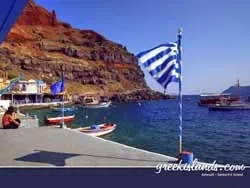
The ancient Greeks understood the universe very correctly: the mighty Ocean flowed around the Earth, full of whirlpools and whitecaps, while the ever-noisy Sea with a capital S spread across the Earth - the best, the most important, the one and only, right in the middle. And this is not surprising: Greece is a very maritime country. Its coastline with turquoise bays, pine groves on the hills, golden sand or white pebbles stretches for 16,000 km. Greek coasts are famous for their purest water and wonderful beaches: 406 of them have been awarded the 'Blue Flag'. But no flags can measure what awaits travelers in Greece - amazing landscapes, cheerful hospitality of smiling locals, wonderful air filled with the scents of herbs and sea. And this incredible feeling of happiness - serene happiness that only exists in childhood.
Holidays on the Greek coast are wonderfully combined with thalassotherapy. More than 4,000 years ago, the Greek poet Euripides recognized the healing and restorative power of the sea, writing: 'The sea cures human ailments.' Today it is officially confirmed by science, which has discovered the amazing similarity between the composition of sea water and human blood plasma. The Federation of Sea and Health claims that even a week-long treatment on the seashore can ensure excellent well-being for the following six months. According to experts, after a seaside holiday and thalassotherapy treatment, the need for medication for insomnia, depression, and stress is significantly reduced. This has already been appreciated by such high-ranking individuals as the Princess of Monaco and members of the British royal family. As a rule, one day at a thalassotherapy center includes four different procedures (baths, showers, seaweed compresses, therapeutic pools, massage, etc.)
The Halkidiki peninsula is one of the most beautiful, happiest, greenest, and most serene regions of Greece. Once the main city of Halkidiki was Olynthos, destroyed in 348 BC. Its ruins still emerge through the veil of time near modern Olynthos - remnants of mosaics that once adorned rich houses, wide streets, fragments of columns... Now the capital of Halkidiki is the city of Polygyros. The peninsula is considered a separate district and holds first place among Greek districts in coastline length: its surf line stretches for 850 km. The number of 'Blue Flags' here is also the largest. Three Poseidon's 'teeth' compete in beauty, revealing cliffs and bays, beaches and lush groves to the eye.
Kassandra
Many call the Kassandra peninsula the most beautiful of the three 'brothers'. Lovely sandy beaches, secluded bays, cliffs covered with pines... It is recommended for holidays with children, yacht trips, thalassotherapy. There are many hotels of various levels, from quiet family guesthouses to luxurious resorts, all kinds of entertainment, vibrant nightlife. At the SANI resort, jazz festivals are held in summer under the starry Greek sky. In Kassandra, at the 'Siviri' theater, the 'Kassandra' music festival takes place all summer.
Sithonia
The main city of the peninsula is Neos Marmaras in the Kassandra Gulf. From its harbor, as well as from the Porto Carras yacht marina, boats go to the islands of Skiathos, Skopelos, and Alonissos. The hillsides in these areas are covered with vineyards, and picturesque old villages have taverns with excellent local cuisine. The village of Nikiti on a pine-covered hill stands out for its special chimneys and bright red roofs of old houses (here they learned to use ruflex instead of the lost old tiles), nearby is a 5th-century Christian basilica. Another lovely village is Porto Koufo, hidden in a rocky bay. People come here to enjoy fresh fish.
Ayon Oros
The Ayon Oros peninsula is the most famous of the three 'brothers'. This is the Holy Mount Athos, an ancient place of Orthodox pilgrimage. Only men can visit Mount Athos, and only with a special permit, but everyone can see it from the sea. Ships depart there from Ierissos and Ouranoupolis, and a sea excursion can be bought at any hotel.
Ayon Oros translates from Greek as 'Holy Mountain'. This place was considered sacred since ancient times: here stood temples dedicated to Apollo and Zeus, the sanctuary of Zeus was called Athos. After the Greeks adopted Christianity, the first monastic hermitages began to appear on the peninsula.