
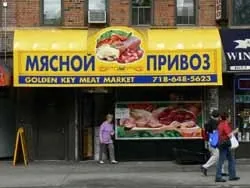
As reported by the Russian Bulletin, published in Boston, our former compatriots are engaged in business in virtually all sectors of the American economy. The catalog of this publication includes real estate and car sales companies, insurance, financial and law firms, computer companies, medical institutions, publishing houses, radio and television stations, construction organizations, travel agencies, taxi services and limousine rental, restaurants and much more. In the émigré community, this entire vast complex is commonly called the "Russian-American bazaar". Today it is in a state of financial depression.
The most striking example of this is the real estate companies owned by Russian immigrants. Nora Pasmanik works as an agent for one such Chicago firm. "My profession turned out to be one of the most vulnerable," she said. "Despite the fact that home sales improved slightly in October and November, housing prices continue to slide. On average, they fell by almost 9% over these months. Accordingly, our incomes have decreased."
Felix Olshansky, owner of a construction company, joined the conversation. According to him, the decline in Americans' purchasing power forced him to abandon the construction of residential homes in the suburbs of Chicago. "We'll survive until better times. I hope the financial crisis will calm down by spring. I judge by the situation on the New York Mercantile Exchange," emphasized the businessman.
Jan Parokhin, manager of the popular Chicago Russian restaurant La Mirage, is very cautious in his assessments of the current situation: "I cannot say that due to the economic downturn, the number of visitors has decreased and our business has suffered. We have not lowered prices, we have not changed the menu, but as before, on weekend evenings all seats in the restaurant are taken. And for the Thanksgiving celebration, which will be held on November 27, seats in all halls of the restaurant and in the bar were reserved a month ago. I think the reason for this is the not so noticeable increase in food prices, and consequently, in the cost of our menu dishes."
The same was stated by Ilya Stolyar, vice president of International Computer Concepts. "Our business, like the restaurant business, depends on the clientele," he explained. "And demand for our service and new computers, even in the financial crisis, remains not only at the same level but is constantly growing. After all, there is no business today that can do without computers." "The financial crisis has not yet reached my domain," declared Yuri Benikov, owner of a plastering and painting company from Portland (Far West of America, Oregon).
There is also another sector that has so far resisted the blows of the financial crisis and accounts for about 20% of the business balance of immigrants from the former Soviet Union. This is the healthcare sector. In every city where our former compatriots live, there are clinics owned by Russian-speaking doctors. The vast majority of their clients are elderly people with free medical insurance. These insurance programs fully pay for the services of doctors of any qualification, and the crisis has not affected this at all.
According to the Jewish Federation of the United States and the Harvard University Research Center, about 800,000 immigrants from the former USSR currently live in the United States. Thus, the Russian-speaking community is considered one of the largest ethnic groups in the country. Its representatives have settled in all major cities, from the East Coast to the Pacific Ocean.