
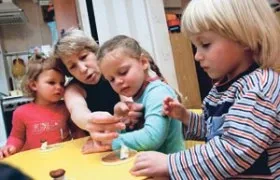
Parents can enroll their children in both state and private kindergartens
It is quite obvious that the parental decision will depend on their personal experience in this area. The obvious pros and cons of attending kindergarten are also determined by certain sciences, such as medicine, sociology, pedagogy, and psychology.
It should be noted that science generally views kindergarten as a positive phenomenon, and even necessary for the full upbringing of a child. This is worth agreeing with, because humans are social beings. The ability to communicate with people, that is, with other members of society, determines a person's future life. Starting from meeting the opposite sex, and later starting a family, ending with workplace communications, communication during job interviews, throughout one's career, and contacts with superiors.
Therefore, it is extremely important to learn communication from childhood. In this case, kindergarten cannot be replaced by even the most caring and communicative parents, grandparents, or hired nannies.
The advantages of attending a preschool educational institution from a psychological and pedagogical perspective are numerous. These include the child's adaptation through contact with other children and teachers, routine, games, activities, organization of various holidays, and learning new skills. This is just a small list of positive aspects. It is also worth considering this issue from a medical point of view.
The biggest disadvantage of attending preschool institutions is, of course, that the child starts getting sick more often. It is useless to argue with this – neither parents nor medical workers deny it. And it is completely natural. Most often, children suffer from respiratory diseases and acute infections. The chance of getting sick increases when the child's social circle widens. Therefore, it is obvious that a child who regularly attends kindergarten gets sick more often than a child who stays at home.
If we look more closely at the fact that the child has started getting sick more often, one can see that it is not so bad. Infectious diseases such as rubella and chickenpox are easily tolerated in childhood without complications, while in adulthood they pose a greater threat to health. And it is difficult to catch these diseases without attending kindergarten. As for colds and acute respiratory infections, the frequency of these illnesses does not determine anything. This is confirmed by the fact that the number of such circulating viruses has a logical end. Each episode of acute respiratory infection builds antiviral immunity, which subsequently reduces the likelihood of illness.
Influenza epidemics and the likelihood of catching it should not be associated with the concept of "kindergarten." Even if a child does not get infected in kindergarten, the flu virus can be brought home by dad from work. But if a child does not get sick "moderately" in kindergarten, they will get sick more often at school. Agree that the damage is less if your son misses a week of kindergarten rather than a week of school.
When children are ill, what matters is not how often they get sick, but how the viral infection proceeds. If a child has an acute respiratory infection accompanied by complications, attending kindergarten has nothing to do with it. Here it is important to pay attention to the child's immunity, treatment tactics, and living conditions.
Let's consider the topic of increased morbidity among kindergarten children. Most parents tend to think that their child got sick again due to violations of childcare rules in kindergarten. They allowed the child to sit on a cold floor, dressed poorly for a walk, created a draft in the room, and so on. If we look at kindergarten from this side, it is a good option to which one can always attribute all the shortcomings of both parents and teachers. The norm is to create greenhouse conditions for the child, supported by numerous instructions on how to properly walk, feed, dress, and bathe. But if a child walks barefoot or there is a draft in the room, this is considered unacceptable.
But there is no need to deceive ourselves, because in the future the child will encounter all of this. Therefore, it is worth preparing your child for kindergarten from birth through adequate upbringing; sometimes an experienced governess is hired for this purpose.
The fact that a child is about to go to kindergarten makes it necessary to have all preventive vaccinations. Because without them, the child will not be accepted into kindergarten. Afterwards, the kindergarten nurse will monitor vaccinations, and specialist doctors will periodically examine the children, which is definitely a plus. Many parents do not see doctors for preventive check-ups, only when the child gets sick.
A special question is the optimal age for a child to start attending kindergarten. Let us leave this debate to educators. For a doctor, the most important thing is what the child's mother will be doing while the child is in kindergarten.
The most common situation: on September 1, the child starts attending kindergarten, and the mother returns to work after maternity leave. A week passes, the child gets sick with an acute respiratory infection, and the mother is forced to take leave to care for the sick child. This does not delight the management – and problems begin.
It is important to understand that a child will often get sick immediately after starting preschool. And this does not depend on how excellent your child's health is or how good the preschool is. The child's adaptation to preschool can last from three months to a year. It is advisable that the mother stay at home during this time – until the child gets used to attending preschool. Because it is very important to have the opportunity to keep the child at home at the onset of illness. This will prevent the disease from developing and avoid infecting other children. It is also not unimportant that the mother will not need to take a medical leave and talk about it with her boss again.
Another important factor is the time when the child starts attending preschool. The most unfavorable period is from October to April. During this time, there are many viral respiratory infections, which will prolong the child's adaptation process.
Many medical issues are directly related to the work of preschool staff. Each teacher has their own opinion on how to properly dress, feed, and harden children. Most of these views coincide: feed at any cost, dress as warmly as possible. It should not be forgotten that the salaries of preschool employees are not very encouraging, and teachers do not want to argue with parents on these issues.
If you understand that sweating is more likely to lead to a cold than hypothermia, or that a child should not be forced to eat if they do not want to, then let your child's teacher know. Because it is important that your child's teacher does not feel guilty that your child refused to eat.
All sensible people understand that no one is immune from sudden illnesses and injuries. With this in mind, preschool workers must have information about what diseases the child has had, and whether they have allergies to medications or foods. It is also important to be able to contact parents in an emergency.
Factors such as the preschool building, the quality and frequency of repairs, the dining room and bedroom, the yard where children play, and the conscientiousness and professionalism of the preschool staff have a significant impact on a child's morbidity. When choosing a preschool, these factors should also be considered. Also, the place of residence and family well-being will play a significant role in the choice.
_