
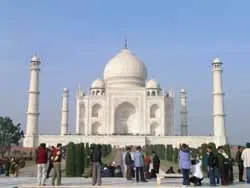
According to the Indian parliamentary committee on tourism and culture, scientists believe that suspended dust particles settling on the white marble of the monument are responsible for the color change. Specialists tried to save the mausoleum from yellowing, but unlimited emissions of sulfur and nitrogen oxides into the atmosphere hinder this. A decade earlier, the Supreme Court of India ruled to close or relocate iron foundries, kilns for firing ceramic bricks, and glass workshops located near the Taj Mahal.
However, all is not lost. Scientists and parliamentarians propose using a special clay-based product to clean the facade. It has been used before and worked very successfully. However, the restoration cleaning process is long and expensive – it takes two months and costs $230,000. Moreover, the cleaning must be repeated every three years, which is unlikely to improve the condition of the monument.
The Taj Mahal mausoleum was built on the banks of the Yamuna River near the famous Agra. The building was erected by order (and possibly with the active participation) of Shah Jahan from the Mughal dynasty in 1630-1652 for his beloved wife Mumtaz Mahal, who died during childbirth. The distorted name of Mumtaz gave the mausoleum its name (later Shah Jahan himself was buried there). About 20,000 people took part in the construction. Historians of Indian Muslim architecture name the famous Persian architect Ustad Isa as the builder of the monument. The structure is a five-domed building about 74 meters high with four minarets around it. On the gate leading to the park complex surrounding the mausoleum, a quote from the Quran is engraved, addressed to the righteous, and ending with the words 'enter my paradise.'
Recall that the Taj Mahal is among the contenders for the title of one of the 'New Seven Wonders of the World.' The worldwide competition, held with the support of UNESCO, has entered its final phase. The final list of ten contenders for this honorary title has been announced. Topping the list are the Maya city of Chichen Itza and the Inca sanctuary of Machu Picchu. Other finalists include the Acropolis, the Colosseum, the Eiffel Tower, the Great Wall of China, the stone statues on Easter Island, the city of Petra in Jordan, the Stonehenge complex in the United Kingdom, and the Taj Mahal mausoleum. The winners will be announced on July 7, 2007, in Lisbon.
_