
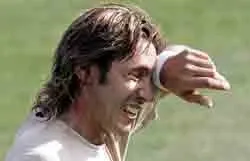
Mostovoy began playing big football back in Soviet times. A product of Moscow's CSKA, he caught the eye of future Spartak coach Oleg Romantsev, who in the mid-80s was gaining experience with the second-league Moscow team Krasnaya Presnya. Mostovoy ended up at Presnya, and then together with Romantsev moved up and transferred to Spartak. He was champion of the Soviet Union in 1987 and 1989, won the European Championship with the country's youth team in 1990, and in the same year moved to the national team, which after the resignation of Valery Lobanovsky was headed by Anatoly Byshovets. And in 1991 he went abroad, accepting an offer from Portugal's Benfica. Since then, for fifteen years he played abroad, where he managed to start a family. At the beginning of this year it became known that Mostovoy decided to hang up his boots, giving reason to recall his foreign career, which was not poor in events.
Few people know, but in the same 1991 Mostovoy almost signed a contract with Bayer Leverkusen, for which Ukrainian Andriy Voronin currently plays. Mostovoy visited Germany and agreed on the terms of a future agreement with the club's management. However, in Moscow he was found by Vasily Kulkov, who had already been playing for Lisbon's Benfica for six months together with Sergei Yuran. Mostovoy's partner from Krasnaya Presnya and Spartak suggested his friend fly over to visit him in Portugal. It turned out that Benfica's management was interested in Mostovoy. After a few days of training with the team, he received an offer from the club's management to sign a contract. The presence of old acquaintances at Benfica and the club's loud name played a major role in Alexander's decision.
Choosing between the German and Portuguese clubs, he settled on the latter, which he later openly regretted. At first, Mostovoy waited six months for his registration to play in the national championship. And when it finally happened, the Swedish specialist Sven-Goran Eriksson (now the coach of the England national team), who had invited Alexander to the team, left Benfica. His place was taken by the famous coach Tomislav Ivic. Kulkov and Mostovoy did not fit into his game scheme and were forced to spend most of their time on the bench. Mostovoy seriously thought about changing clubs, and even Ivic's dismissal did not change his plans. But the contract with Benfica was signed for as many as four years. Alexander considers this period of his career the most unsuccessful.
A way out was found at the end of 1993. The management of French club Caen turned to Benfica's bosses with a request to give them Mostovoy on loan until the end of the season. Caen were second from bottom and needed a "joker" - a player brought in to strengthen the club. Caen's bet on Mostovoy fully paid off. In his very first match he scored a goal, and the team won for the first time that season. Thanks to Alexander, Caen left the relegation zone and finished the season in the middle of the table. At the end of the championship, in 1994, Caen's coach Jeandupeux received a lucrative offer from another French club, Strasbourg, and persuaded Mostovoy to move with him.
The new team turned out to be slightly stronger than the previous one. It is worth noting that the famous Franck Sauzée (winner of the Champions League with Marseille) played for it. Mostovoy played two seasons at Strasbourg simply brilliantly, and he was constantly included in various symbolic teams at the end of the season. There were also tempting offers from strong French, Spanish and German clubs. However, the president of Strasbourg decided to keep Mostovoy at any cost and began to play a double game. He promised Alexander that he was ready to let him go to any club for an appropriate sum. But when representatives of clubs interested in acquiring Mostovoy turned to the president of Strasbourg with concrete proposals, he asked astronomical sums for Alexander. A week before the end of the player registration period, representatives of the modest Spanish club Celta approached Mostovoy and the president of his club. And it was they who unexpectedly managed to reach an agreement with both.
"The club owners broke agreements on salary size," the footballer recalls. "They didn't seem to refuse their promises, but they delayed fulfilling them. I started negotiations with German clubs - Stuttgart and Kaiserslautern. Repeatedly we seemed to reach an agreement, but Strasbourg at the last moment exorbitantly increased the compensation for me. Finally my 'owners' gave in, but offered me a club I didn't know before - Celta from the city of Vigo, which I didn't know either. There was a week of additional registration left, and I took a risk. The city of Vigo, though small, has one of the largest ports in Europe. So the club had money, even though it was not in the best condition. At first I was known as almost the main 'troublemaker' - I constantly reminded the club management: 'Why are you spending money on buying players rather than improving the infrastructure?' At that time, the fields, training facilities, and changing rooms at Celta were worse than at most Russian top-league clubs, and maybe even first-league ones. Didn't I make enemies by this? At first many were annoyed. But then they came to terms and even recognized the fairness of my demands. And after a few years I was elected team captain..."
Before the Russian's arrival, Celta was mainly focused on surviving in the Spanish top division. After Mostovoi appeared, everything changed. Even the giants of Spanish football, Real and Barcelona, began to reckon with Celta. The fans believed in the team, and sponsors started investing money in it. Following Mostovoi, other well-known players appeared at Celta: Israeli Revivo, Brazilian Mazinho, Frenchman Makelele, and another Russian, Valery Karpin. With the arrival of these footballers, Celta began to play spectacular, combination football. And two Russian midfielders played the main role in the team. It is not surprising that Celta was called "Russian." Almost everything suited Mostovoi in Vigo: the terms of the contract (which could only be revised upward), the attitude of fans and journalists toward our footballers, and the football that Celta played.
But the year 2004 came, which proved to be a turning point for the footballer. Mostovoi's career went into decline. It began when Georgy Yartsev, who had taken charge of the Russian national team, brought the footballer back into the national squad, which had scraped through to the European Championship. Mostovoi again became one of the key players of the national team, but after the very first match at Euro-2004, lost to the Spaniards, the footballer was thrown out of the training camp amid a scandal. The reason was an interview given to Spanish journalists immediately after the final whistle. Mostovoi was accused of defeatist attitudes, insulting the coaching staff, and other sins. The official formulation was "unethical" and "untimely" remarks in the press.
The footballer himself claimed that he had said nothing of the sort, and that his words were simply twisted by journalists from one of Spain's leading publications. Mostovoi had to say goodbye to the national team, for which he had always played with pleasure. After an injury sustained in the national team, Celta's management strongly urged Alexander not to play for the Russian national team. However, the midfielder stated that he had never refused and would never refuse to play for the Russian national team.
Mostovoi had lived abroad too long and probably forgot the customs that reign in Russian sport. The boss is always right, and there is nothing to be done about it. Alexander, however, was used to being able to express his opinion, but never took things to a serious conflict. It is unlikely that Yartsev would have managed to teach a 36-year-old player, a mature man and a very popular footballer, for whom fans of the Spanish Celta planned to erect a monument in the center of Vigo, to behave "differently."
When the scandal broke, journalists also recalled that Mostovoi, without notifying anyone of his absence, quite often disappeared from Celta's camp rather unexpectedly. They said that this footballer was uncontrollable, and therefore there was nothing surprising in his stunt. But, by and large, this does not correspond to reality. Mostovoi will be remembered by fans and experts not as a scandal-monger, but as a successful footballer who won the love of foreign fans and earned the nickname the Russian Tsar. And people's love, you will agree, is not easy to earn.
There is nothing surprising in the fact that this very talented midfielder, one of the best players in the modern history of the Russian national team, became accepted in the West. Mostovoi is a very sociable person; he easily and fairly quickly learned the languages of the countries in which he played. He has a good command of Portuguese, French, and Spanish.
Mostovoi's personal life, one might say, is unusual. After moving to Benfica, in order not to be considered a foreign player in the team, he had to enter into a fictitious marriage with a Portuguese citizen in 1991. At that time, there were still restrictions on foreigners, and therefore Benfica, like many other clubs, had such ways of solving problems. Subsequently, Mostovoi admitted that he never once saw his "spouse." The breakup with the Portuguese wife, which no one ever mentioned, apparently occurred after the footballer moved to France. There Alexander met Stephanie, a student at a local university. Soon she had to interrupt her studies; a son was born, named Sasha. Three years later, when Mostovoi was already playing for Celta, a daughter, Emma, was born. But then the family fell apart. Some sources claim that this happened in 2003. The reason was marital infidelity.
Now he is a completely free man, not occupied with training and lives for his own pleasure—he can afford to sleep longer, go anywhere, and come back whenever he wants. After Euro-2004, he left Celta, whose management owed him a considerable sum. Alexander claims that this money would have been quite enough "for a year of comfortable living." He was invited to earn extra money in Qatar and Saudi Arabia, and in Russia. But he accepted the offer of the modest Alaves from the second Spanish division. The boss of this club, Dmitry Piterman, is an American born in Odessa. But after playing only one match for this team, he said goodbye. He says it was for personal reasons.
Having hung up his boots, he has not yet decided on his future occupation. Basically, Mostovoi has a small business. In his day, from a country where people preferred to keep money in glass jars, he ended up in Portugal, with its real commercial banks, and learned a lot: "Everything we earned at Benfica was transferred into the bank for us; the club president was its owner, so immediately after signing the contract an account was opened there, into which both salary and bonuses were credited. Choosing a bank, as far as I remember, was not possible."
I liked the system and, having moved to France, I asked to open an account for me in a local bank. I was taken to BMP (there is such a bank in France). Then, having left for Spain, I kept this account. I once tried to open another account in another place, but then changed my mind. It's more convenient. They say that you shouldn't put all your eggs in one basket, but I think that troubles can happen in life not only with the bank, but with anything. It's somehow silly to try to insure against all possible risks. You won't be able to anyway. You can invest money in stocks or real estate. But this option is not always reliable either. And in general, I work with different financial instruments, but not myself, but with the help of a consultant. Loans? Yes, in Spain many take a loan for 20-30 years and then pay it off. I have never borrowed money for such a long term, but in general I have had to use credit. Mainly for large purchases.
Apparently, Mostovoy is going to live in Spain. “It seems to me that this country was created to live and enjoy it. It’s so convenient and comfortable…” But at the same time, he never fully became a person with a Western mentality. “Did I become one of my own here? In my soul, I definitely remained Russian. No matter how many years I played and lived abroad, I still think in Russian. Just as I swore in Russian, I still swear. I remain a Russian person…”