
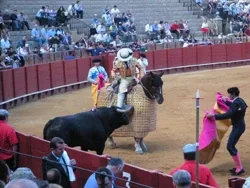
An hour before the performance began, it was impossible to get through near the stone walls of the arena stadium in the town of Montemor-o-Novo, a hundred kilometers from Lisbon - hundreds of eager people dreamed of getting into the bullfight. The last two autumn months are the peak of the bullfighting season in Portugal. Although this season has no official start or finish, it is in October and November that performances involving a bull, a man and a horse are staged more often...
It cannot be said that my three companions and I were completely unprepared. We knew that in Portuguese bullfighting, unlike Spanish, the bull is not killed. In addition, we had heard that the cavaleiro (the analogue of the Spanish torero) fights the bull not "on foot" but on horseback. And finally, we were told that there is another feature of Portuguese bullfighting - some mysterious forcados. But we were to see all this with our own eyes for the first time.
Cavaleiro
The bullfight begins with a ceremonial riding display called the cartesianos. Just imagine: a young, elegantly dressed cavaleiro on a prancing stallion, accompanied by an entire entourage, shows the audience a white-toothed smile and his ability to control the horse. The rider's costume is a true work of art: expensive fabrics, embroidery, beads. They say that these costumes are inherited. Possibly, but as a rule, cavaleiros try to acquire their own equipment appropriate to their status. This tradition dates back to the 15th century, when only aristocrats acted as riders. By the way, "blue blood" was then a mandatory condition, but gender was not. It is reliably known that female riders have entered the arena since the 18th century, but there is evidence that this happened earlier.
Having given due attention to the cavaleiro, one cannot help but mention his fighting companion - the horse. Anyone who understands even a little about horse riding or simply loves horses will not be left indifferent by Portuguese bullfighting. Controlling a horse even in a calm environment is an art. If the atmosphere cannot be called peaceful, then the rider must be a true ace. The horse and man on the arena form a single whole. The grace and spectacle of this deadly dance are simply mesmerizing. The cavaleiro must trust his horse completely, because, according to bullfighting experts, if the horse does not want to go at the bull, not even spurs will force it. Moreover, only in Portuguese bullfighting can you see a rare sight - the frontal fight between rider and bull. In Spanish bullfighting, such a head-on collision is impossible. Of course, special breeds of horses are suitable for bullfighting - Lusitanos and Andalusians, mainly stallions. Interestingly, the desire to fight is inherent not only in the rider but also in his horse. In fact, two duels take place in parallel on the arena: a man fights a bull and a bull fights a stallion.
Our neighbor in the stands turned out to be a lady of Balzac age - a passionate fan of bullfighting, which she has enjoyed since the age of five. The lady became a kind of guide for us. "These are not three-year-old stallions," she commented, "but horses of age. Stallions are usually taken for bullfighting at about ten years old, and for another ten years or more they enter the arena. Of course, each rider has more than one horse, and he can change it during the fight, but only on the signal of the senior judge. There he is, sitting in the center." We stretch our necks in the direction of her gesture and notice a skinny gentleman who, without looking away, watches the action in the arena. "A cavaleiro can himself make a gesture to him indicating that he would like to change horses, or the judge acts on his own initiative," continued our new acquaintance.
The horse has to be changed because it could be injured. More precisely, the bull can quite noticeably hook it under the belly with its padded horns (we got to observe this trick several times that evening), or even knock it to the arena and trample it with its hooves (we were spared this sight). The horse can also be injured by the rider himself - after all, he uses spurs. This entire cruel performance is played out with a single purpose: the rider must plunge a lance into the bull's withers.
"A cavaleiro, of course, must try to hit exactly the place where the neck meets the torso," explains the neighbor, "but even more important is to correctly win the space, using a limited number of lances (they are called banderillas), and to exhaust the bull's strength so that the forcados can come out."
It turned out that the class of a rider is also determined by whether he can fit into the seven banderillas allotted to him by the regulations. In the performance we attended, only the first participant showed such skill - Manuel Teles Bastos, who turned out to be a hereditary cavaleiro. According to our interlocutor, his grandfather amazed his compatriots with his art about twenty to twenty-five years ago. Other riders asked the judge for permission for an additional two or three banderillas.
In addition to the number of lances, their length and design features are regulated. For example, the tip of the first lance remains in the bull's withers, while the shaft stays with the rider. A small flag with the cavaleiro's coat of arms or the sponsor's logo of the performance unwinds on the shaft. With this flag, the rider diverts the attention of the bull that has received the first prick. The second lance is the same length as the first, but there is no flag. But starting from the third, the length of the banderilla decreases, and the lance itself remains entirely in the bull's withers, so the rider has to use all his skill to escape the bull's fury. The rider makes the last prick with a very short lance called the palmito.
Does all this really go unpunished for the cavaleiro? “They can wound him, but that happens rarely,” replies our guide. “It is rather evidence of his lack of skill or an extremely unenviable set of circumstances. But such cases have happened. You have probably noticed that all riders wear a black bow on their heads? It is said that this is in memory of the most famous cavaleiro - the Marquis de Marialva, who lived in the 18th century - a bon vivant, an aristocrat, and a desperate daredevil who, according to legend, fell in the arena during a bullfight.”
Forcados
If the cavaleiro is the beauty and strength of Portuguese bullfighting, then its courage and agility are the forcados. Can you imagine a madman who would enter the arena to literally grab a bull by the horns? And what a bull! Bulls for bullfighting are a specially bred breed distinguished by particular ferocity. A kind of machine weighing five hundred to six hundred kilograms. And although a day before the bullfight the bull's horns are placed in special plastic or leather cases connected by a crossbar on the forehead, even with covered horns the animal is extremely dangerous.
So the forcados are exactly those madmen who try to put an old saying into practice. Meanwhile, of armor they have only canvas shorts-trousers, blouses, red belts, and jacket-coats. And ties, of which every self-respecting forcado has two: black and red. The first is worn on occasions of mourning, the second in all other cases. The forcado da cara (which literally means ‘face forcado’ - he takes the bull's charge) also has a green cap, but this piece of attire, you will agree, poorly protects in a head-on collision with the animal.
The forcados work as a team of eight. In addition to the aforementioned cara, there is also the rabejador - whose task is to hold the bull by the tail, one person from the so-called first help, two from the second, and three from the third.
What does the team play of the forcados look like? At the end of the rider and bull confrontation, when the enraged horned beast attacks the capotes (panels of bright pink-yellow color that are waved by the capadores, known also from Spanish bullfighting), the forcados team jumps onto the arena in a synchronous leap over the barrier. A minute for consultation, and now they have lined up in a battle wedge: the cara in front, behind him the first help, then the second and third, and the rabejador closes the formation. The cara separates from the group, puts on the cap, hands on hips, and step by step approaches the bull. If after the first two passes the monster does not notice the hero, he attracts its attention with shouts. To the Russian ear they sound quite melodious, but the intonation with which the words are spoken leaves no shadow of doubt as to the insulting content. Sooner or later the bull notices the fighter and, naturally, rushes at him with fury. Boom!!! The culmination point arrives. With a favorable set of circumstances, the cara remains standing on his feet, holding onto the horns, and the first, second, and third help closely surround the bull, allowing the rabejador to perform his role - to take the animal by the tail. When the bull is successfully stopped, the seven fellows jump back, and the freed beast tries to deal with the rabejador, spinning and trying to reach him with its horns. In an unfavorable outcome of the duel, the bull either throws the cara over itself, or tramples him with its hooves, or with a deafening crack slams the daredevil into the barrier of the arena.
That day two teams competed in the arena - in crimson and spotted jackets. Each had two bulls. However, if in the first two bouts the forcados, one might say, were lucky - the bulls were stopped without serious injuries, then in the third and fourth rounds the people had to show courage and the will to win. The fourth bull dragged the cara and his seven comrades across half the arena. Overall, the spectacle we witnessed, according to experts, was bloodless: a couple of fractures and a few dislocations - is that really damage?
Of course, the success of the forcados depends to a considerable degree on the agility and art of the rider, who before their appearance wears out the bull. The last two cavaleiros, according to our neighbor, did not prove themselves to be skilled fighters, but on the other hand, the bulls they got were excellent - fierce and strong. So it is no wonder that the third forcado da cara had to try twice to stop the bull, and the fourth even three times. Yet blood, bruises and fractures are the only reward for the forcados. “They do not receive money for performing,” emphasized our guide into the world of bullfighting, “they do all this for pleasure. The cavaleiros, of course, earn a lot. The most famous riders live comfortably. The people come to see them, their names are on the posters and tickets, and the forcados... This must be in the heart. Either you can look the bull in the eyes and not run away when it charges at you, or you cannot. As a rule, forcados are the most desperate heads.”
It is not hard to guess that becoming the girlfriend of a forcado is the cherished dream of many Portuguese señoritas. The girls behave in the most inappropriate manner at the performance: they shriek, spin around, jump up. Beautiful creatures aged 12 to 17 kept flitting before our eyes, showing off their lovely legs. And at the end of the bout, when the forcado da cara and the cavaleiro make a lap of honor around the arena, the ladies are altogether reminiscent of Beatlemaniacs at concerts of the Liverpool Four back in the 60s: everything flies into the arena - from dolls to items of ladies' attire. It is considered a good omen if the fighters pick up the ‘talisman’ and send it back to its owner, who is breathless with delight. So the end of each performance is a kind of volleyball between the arena and the amphitheater.
Afterword
We were lucky: besides the fights involving riders, bulls and forcados, we saw something else. At the end of the performance, children came out into the arena. To be honest, we felt a bit uneasy. After all, among the "mini-forcados" there were boys of five or six years old. The atmosphere was lightened by a joke from one of my companions: "Are they going to release a cat on them, or what?" It turned out not a cat. We watched a fight of infantis (as future forcados aged 10-14 are called) with a young heifer. After the infantis, the little ones came out for a "fight" with a calf, accompanied by their older brothers and fathers. By the way, for the older generation, the holiday continued after the performance, when the forcados went off to local pubs.
I, however, still had one question left, which I asked our kind lady. Since the bulls remain alive, why not release them into the arena several times? The woman laughed: "Then the cavaleiro would not even have time to ride out gracefully. This beast learns everything so quickly that by the end of the fight it matches the rider in skill. So the latter is saved by the agility of the horse and the considerable worn-out state of the opponent. And what would happen if the bull were treated and released again?"
What happens to the bulls afterwards? They are usually eaten. The best ones, though, are treated and kept as breeding stock. After all, the wounds inflicted in the arena are by no means fatal. "Of course, blood is blood," nods our guide, "but on the other hand, cows drive the bulls from the arena into the stall. And many of the bulls, after finishing the fight, perform their marital duties excellently as soon as they enter the stall. And if they are capable of that, then not everything is so bad..."