
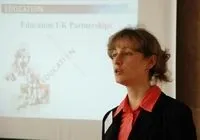
One of the areas of the British Council's work in Ukraine is consultations on education and cooperation with educational agencies and British educational institutions. And at the end of September, under its auspices, a significant event will take place in Kyiv and Odesa - the First International Festival of Modern British Education. "Zagranitsa" asked Svetlana TYMOSHENKO, Learning Opportunities Project Coordinator at the British Council, to tell more about it and share her observations on the trends of mutual interest between British universities and Ukrainian students interested in studying abroad.
- Svetlana, please tell our readers how this event will take place and who its participants are.
- The festival will take place in Kyiv on September 20-21 at the Exhibition Hall of the Ukrainian Chamber of Commerce and Industry (33 Velyka Zhytomyrska St.). And in Odesa it will be held on September 22-23 at the Marine Gallery (6 Prymorska St., Marine Terminal).
26 British educational institutions from England, Scotland, Wales and Northern Ireland have registered to participate in the festival. Among them are prestigious private schools with centuries-old traditions of upbringing and comprehensive education, language educational institutions that teach more than 700,000 people a year from around the world. The Ukrainian public will have the opportunity to get acquainted with seven state universities of Britain, including the University of Central Lancashire, Glasgow, the University of Portsmouth, Warwick. Their representatives will gladly offer the opportunity to obtain a worldwide recognized higher and postgraduate education in the fields of business, international economics, international law, marketing, e-business, ecology, architecture and many others.
Most of these universities plan to introduce a program of issuing mutually recognized diplomas jointly with Ukrainian higher educational institutions. And some of them, for example the University of Central Lancashire, are already implementing such programs with Ukrainian partners. This is of great importance in the context of the Bologna process.
Numerous Ukrainian educational and travel agencies that cooperate with British partners will also take part in the festival.
Throughout the festival days, there will be original educational presentations by participants, methodological seminars for English teachers, and professional presentations for educational and travel agencies. Special events will be held for the business community: presentations of MBA courses from British business schools and business English language courses. Competitions and quizzes will also be organized, with scholarships for studying in Britain and valuable prizes from the British Council to be raffled off.
We hope that the festival will be of interest to representatives of business companies, especially those responsible for making decisions in the field of professional development of their personnel, leading Ukrainian schools, universities, as well as international educational institutions of various levels operating in Ukraine.
- And what was the basis for the British Council's decision to hold such a large-scale educational event in Ukraine?
- For eight years now, working on the project 'Education in Britain', we have observed a constant increase in the number of requests from Ukrainian citizens regarding education in Britain. On the part of British educational institutions, the number of requests and visits to our country is also increasing, that is, there is an obvious increase in mutual interest. Over the past years, the goals and activities of the 'British Education' project have changed according to the situation on the Ukrainian market. The desire to organize such events has long been discussed by our colleagues, but the opportunity to implement such a large-scale event has only appeared now.
- Are similar events held in other countries of the post-Soviet space?
- Yes, for example, in Russia international educational exhibitions have been held for a long time and on a larger scale. They are supported by the British Council in terms of visual materials and attracting British educational institutions. In addition, the British Council in Russia itself organizes exhibitions of specifically English education, in which dozens of educational institutions from the UK take part.
But I think that it is not worth drawing any analogies, because Russia is a country of a completely different scale both in terms of population, natural resources, territory, and, as a result, the educational market. Moreover, in the West, many still have little idea about the former republics and their independent development. Ukraine is lucky in this regard. The events of autumn-winter 2004-2005 attracted the attention of the world community to our country and, accordingly, increased interest in the Ukrainian market.
This year we are holding the First International Festival of Modern British Education. Next year we are planning the second one. So we will continue working in this direction.
- What is the dynamics of Ukrainian youth going to study in the United Kingdom?
- To be correct, we will refrain from providing statistical data. They are quite difficult to calculate. But we have observed a constant increase in the number of Ukrainian youth going to study since 2001 (previously we simply did not count). The most active cities in this regard are Kyiv, Odesa, Donetsk, Dnipropetrovsk, Lviv.
By the way, this does not mean at all that all young people leave with the aim of staying in Britain. The vast majority return. And according to the latest survey, a very small part of young people intend to leave Ukraine forever.
- What areas of study, in your opinion, interest them the most?
- The most popular direction is, of course, studying English. This is understandable, given that Britain is the country of origin of this language and a country that speaks this language. Recently, there have been more and more requests and, accordingly, trips for postgraduate education to universities and business schools in economic specialties, including MBA. The number of requests from parents who would like to send their children to private British schools or international colleges is also increasing.
- And what specialties are in particular demand?
- As I already mentioned, business specialties remain the most popular, but there are requests for fashion design, interior design, architecture, and interest in scientific specialties is growing.
- What would you advise those who plan to go study in Britain to pay attention to?
- To everyone interested in British education, I would advise carefully studying the materials on the website www.educationuk.org and following events at the British Council Ukraine on our website www.britishcouncil.org. The British Council regularly holds presentations, consultations and other events dedicated to English education.
- Do you have feedback from those who studied in foggy Albion? What impressed them most about the Western education system and way of life?
- The hardest thing for our youth is adapting to the British environment, culture and language. Many who go to Britain for the first time, especially minors, experience culture shock. But on the other hand, children and young people adapt quite quickly, and then everything goes well for them. Those who go to study in their specialty have difficulties with English at first. But this also passes over time.
And in general, Britain hosts so many foreign students that everything is provided there to help them adapt and study calmly. The very friendly attitude of teachers and educators, the constant smile on the faces of the British, and attentive service have a favorable effect on our students.