
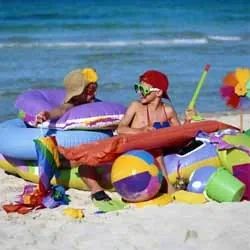
Only parents can decide whether to take a baby on an exotic trip, plan a vacation specially for an infant, or stay at the dacha. Medicine is powerless here. Because medicine insists on one thing: children are not adapted for multi-hour flights, changes of climate and diet, foreign microbes are harmful to children, and the Colosseum is not capable of making the slightest impression on them.
And now close the magazine "Health", turn off the computer, forget yesterday's grandmother's hysterics about planes falling every evening, and listen to yourself. Feel for yourself and for your dear child - and you will know whether to take him with you or not, and if so, where.
Packing the suitcase
The size of family suitcases depends on the age of the children. The younger the children, the bigger the suitcases. If the age is "potty", the potty becomes an essential item. Of all the luggage, it will come in handy first - at the airport, and then on the plane. Or on the train.
If the age is again "potty-stroller", you'll have to take a stroller. This simple item will help you out, as it will become a mobile home for the baby. For example, when it's time for the child's nap, and you don't want to leave the bar. As is known, children are deeply indifferent to how loud the music is when they sleep.
Fears about "airplane overload" are usually exaggerated. During takeoff and landing, you should give the baby water or a lollipop - he won't even feel his ears "plugging up". Much worse is if he has to be bored during a long flight. So for the plane, stock up on picture books, a favorite toy, a player with fairy tales. It's better not to take small construction sets on a plane - later they are picked up under the seats with the help of all the neighbors. The most reliable cure for travel boredom is a new toy bought at the airport or right on the plane.
You don't have to stuff your suitcase with warm clothes, one is enough. But put shoes with a reserve. Take cotton clothes and simpler ones; your little ones are unlikely to need ball gowns. When going on vacation, some take inflatable pools with them. As a rule, they are used once and then forgotten in a corner. So it's better to splash in the warm shallows and build sandcastles - a child finds it much more interesting than in a rubber pool. If you need to put anything in, it's an inflatable ring.
You shouldn't pile up toys either - lots of impressions and your imagination will make up for their lack. Better to put in an album with markers and a couple of books. After all, on the seashore the best toys are colorful shells and pebbles. And buckets, spades, and a ball can be bought at a beach shop.
Packing the first aid kit
The first aid kit takes a special place in the suitcase. Even if forecasters don't promise extreme heat, stock up on sunscreens. Take, for example, a children's protective cream with a factor of at least SPF20 and something like "Panthenol" spray after sunbathing, cosmetic milk, cream or powder for skin irritation. It's also a good idea to put an ointment for bruises and calendula tincture in the first aid kit. Calendula can treat a scratch and gargle with it.
Don't forget to take a box of band-aids, cotton balls and swabs. Allergy remedies will come in handy: in the first few days, a child may easily sneeze not from a cold, but from unfamiliar smells and tastes. Stomach and fever reducers are a must. Aspirin is first and foremost: it will help both against colds and overheating.
Children's menu
Baby food and diapers are the same all over the world, so don't drag "Nestle" cereal with you; better to bring an immersion heater and bottles for baby food. Be careful with local delicacies; it's better to choose food for the baby that is similar to what he is used to. By the way, in all civilized countries, restaurants have children's menus and high chairs.
Follow the main rule: don't stress too much about forgetting something. Most likely, you're not going to a desert, and in all other places you can buy everything you forgot to throw into your suitcase.
PALACES OF SAND
What could be better than the sea? What could be healthier, more interesting and more fun? It's not for nothing that most children's sanatoriums and health centers are located on sea coasts. True, these shores are adapted for holidays with children to varying degrees.
It is known that there are places in the world that are extremely beneficial for children's health. For example, Yevpatoria. This city has a wonderful microclimate, exceptionally healing; even diathesis goes away by itself there. In Yevpatoria there are sanatoriums, hotels, private apartments, shops, markets and restaurants, squares and children's parks with rides, relatively clean beaches, a port with boats and a railway station - everything needed for a holiday with children.
Any child will feel no worse than in Crimea in the Mediterranean. Everything suits: Greece, Italy, Spain, France, Croatia, Montenegro, Turkey, and Bulgaria is no worse - depending on how much money you have. In Greece, life-giving eucalyptus trees will rustle above you, in Montenegro - phytoncidal pines, in Italy - refined pines, and the air is saturated with everything it should be saturated with by the sea. Bulgaria is even considered the capital of children's holidays: it's warm, clean, cheap, and there's a lot of fruit.
Montenegro is simply made for holidays with kids. Untouched nature, clearest sea, beautiful landscapes and good prices are guaranteed at any resort. You can stay in a private house or in apartments with a kitchen. Montenegro has 117 sandy, pebble and artificial beaches with a total length of 73 kilometers; the swimming season lasts from mid-May to the end of October.
One of the most pleasant places is the Budva Riviera, centered on the town of Budva. The old town has a Venetian fortress with bastions, narrow streets and quiet cafés, while on the outskirts there are hotels surrounded by lush greenery with green mountains framing the landscape. The beach in Budva is of fine pebbles, and some hotels are in the town itself, so for a holiday with children it is better to choose one of the Riviera resorts. For example, Becici with its magnificent sandy beach and hotels near the sea. Or Milocer, which is home to one of Montenegro's most picturesque beaches, Queen's Beach.
The charming town of Petrovac stands on the shore of a small bay surrounded by pine forests, on a beach of sand and pebbles. Ulcinj is called the “sunny city” because of its warm and mild microclimate. It is the oldest and southernmost of Montenegro's towns. The Ulcinj Riviera stretches for 30 kilometers, of which 24 are sandy beaches, including beaches of quartz and black sand. The longest of them is called “Velika Plaža” and runs for 13 kilometers. The sand here contains coral remains and has a healing effect; it treats arthritis and muscle diseases. At the Herceg Novi resort there are no sandy beaches, only large pebbles and concrete platforms.
In Spain, the Catalan town of Salou is considered the most “kindergarten-friendly” resort: it is no accident that the wonderful theme park PortAventura is located just a stone's throw away. This area has clean white sand, a shallow warm sea, and many amusements for children and adults. Last year, the resort of Besalú was officially declared family-oriented.
In Turkey, many hotels offer children's entertainment programs and mini-clubs. This is called “animation”. In the club, children are sorted by age and entertained. The older ones learn windsurfing and dance at discos, while the little ones draw pictures on paper and on their own faces, play active games, and learn songs. All this is extremely popular with children of all ages, from all backgrounds and languages: they have never heard of language barriers and feel nothing of the sort.
In Turkey there are many hotels that are great for a holiday with children. The best of them are: Lykia World in Fethiye, Club Pine Beach in Belek, Asteria Club in Side, and many in Kemer: Belkoy Club Hotel, Ceylan Intercontinental Resort, Hillside Ma Biche Hotel, Kiris Alinda Beach Hotel, Limra Limak Hotel Resort, Magic Life Der Club Kemer, Magic Life Der Club Kiris, Magic Life Der Club World, Marco Polo Club, Marti Myra, Phaselis Club, Pirates Beach Club, Renaissance Antalya Resort, Rixos Tekirova Club Hotel, Salima Beldibi Club, Simena Club, Turkiz Hotel, Zigana Club.
IT'S FUN TO WALK TOGETHER
If a child is already past infancy, it makes sense to think about a trip without parents. Especially since vacation time and school holidays do not always coincide. A holiday without parents can be arranged both for independent teenagers and for those who are not yet eager for complete freedom.
An independent holiday means either a health camp or a sightseeing trip. Health camps can be domestic, in the near abroad, or in the far abroad. In our country there are still many such establishments, and for breakfast they still serve semolina porridge, and after lunch they are put down for a nap. Toilets are on the floor, and the shower is in the basement or in a separate building, with hot water according to a schedule. The recommended age for their residents is from seven to 14 years.
To send a child to a health camp, it is enough to contact a travel agency specializing in children's holidays and buy a voucher. The company will take care of everything else: it will gather a group of children and send them with chaperones to the camp, and then bring them back.
In the far abroad, things are different. There you can find international children's camps that usually take teenagers from 10 to 16, sports and youth camps where both schoolchildren and students can rest, as well as hotels and cottages. For example, a very nice village of cottages is located in the Bulgarian town of Pomorie. Its residents, aged from 16 to 19, are quite independent people; they do not need fences and strict rules, but three meals a day is by no means superfluous. More traditional international children's camps exist in many countries: in Slovakia, Hungary, Bulgaria, Lithuania, Croatia, and Montenegro. Especially many of them are in Bulgaria. There they gladly accept both individual travelers and organized groups - dancers, athletes, musicians. For any “thematic” group there is a corresponding camp - with courts, a dance hall, or a club. In countries with a sea, camps are located on the coast. Where there is no sea, children's complexes are built in nature reserves: in forests, mountains, or by lakes. Such camps can be found in Slovenia, Hungary, the Czech Republic, and Germany. They are usually considered sports camps, where you can ride horses and bicycles, go on hikes, and swim in a pool.
The advantages of foreign camps are obvious: a healthy environment, a high level of safety, many opportunities for sports, and wholesome and tasty meals based on specially designed menus. As teachers say, an international camp is the best way to free an inhibited and shy child and help them believe in themselves. Life in these camps is fun: numerous sports competitions, festivals and discos are held. There is also all the romance of childhood and youth, with hikes and night campfires.
In Italy, Spain, Turkey, and Greece, children's camps are most often organized in hotels on the seashore, without hikes or campfires, but with discos, excursions, beach volleyball, and sometimes windsurfing. In some Turkish camps organized by Russian travel companies, both the director and most of the staff are Russian-speaking. In Greece, there are real Scout camps. They are distinguished by Spartan conditions: teenagers live in tents or wooden barracks and do a lot of sports.
An alternative to a camp is an excursion trip. Unlike adults, children do not faint at the words “bus”, “train”, and “overnight transfer”. Because they love to travel and are ready to do it in any way. In recent years, the geography of school tours has “grown up” significantly: children’s groups travel all over Europe, visiting sights and amusement parks.
The lion’s share of sightseeing tours are trips to Paris. As a rule, bus routes to the Eiffel Tower begin after a rail transfer to Brest or Warsaw. Almost all of them include a visit to Euro Disneyland. In summer, a two-week trip through Warsaw to Paris and Nice with a rest on the Côte d’Azur looks especially tempting. Routes in Eastern Europe are usually shorter, and therefore less intense and more thorough. But this is not bad at all: it is still unknown what will remain in a teenager’s head from a week-long race through two countries a day.
But in five days spent in Prague, you can make friends with the knights and saints guarding Charles Bridge, examine all the towers of Prague Castle, stand in dim cathedrals, and take a leisurely stroll through museums. In a word - soak it up. Another plus is that in such stationary sightseeing trips, entertainment such as discos at the hotel is provided for young “bandits”.
TRAVEL FOR LANGUAGE
You can combine business with pleasure and send your child to a “language” camp during the holidays. Most often this is called “foreign language courses in a certain foreign country”. It will be very successful if such a camp is located on the seashore and you can combine study with relaxation. After all, it’s vacation!
If the issue of learning a language is acute and fundamental, the child should be sent to a summer school in the country of the language being studied. Moreover, for the entire vacation. And if the goal is to help the child get comfortable in a language environment, not forget the language over the summer, and at the same time have a good time, you can buy a voucher to a camp with training for a couple of weeks.
Of course, it is much more effective to learn a foreign language in the country where it is spoken. There are a great many such offers: for the holidays you can go to Australia, England, the USA, Ireland, New Zealand, Spain, France, Germany, Italy, Switzerland, Canada, South Africa. It is clear that you can’t just pop over to New Zealand for a week, but Europe is quite accessible for a short stay.
Since from vacation you also want rest, and sea, and sun, and new impressions, most parents choose international language camps in resort areas: in Malta, Cyprus, Greece. This is the cheapest and least burdensome way to speak English during vacation. Language camps in Malta, Cyprus, and other countries play their role - they instill in a child an interest in a foreign language and help overcome the language barrier. As a rule, classes there are conducted in a playful form, and communication with peers from different countries stimulates the use of a common language.
The same, but in the UK, costs more and requires more effort from the child. Companies with experience in organizing children’s language trips will help you choose the most optimal option for your child. Having studied abroad, a child is unlikely to master sciences better than he would have done at home. But still, life overseas benefits children: they learn not only the language, but also independent living, learn to be free and practical. And as for how their horizons expand - there is no need to even mention it!
As, for example, in the youth camp Bad Honnef in Western Germany. Here, besides excellent conditions for sports at the Bad Honnef international center, an interesting excursion program “Hello, Europe” has been developed. During two weeks at the camp, children will visit Holland, Belgium, Luxembourg, France, and, of course, travel around Germany itself.
There are a great many international language schools and camps in Malta. The main language is English. Children live and study in different hotels, for example, in “Holiday Village” or “Solana”. Here you can also not study, just relax: classes are paid separately. The routine is approximately this: in the first half of the day - lessons, then the beach. In the afternoon - the beach and excursions, in the evening - discos and parties. The events are organized by English teachers, so they become language practice. At the same time, there is time for sports, classes are conducted with an instructor. At the end of the two-week shift, the child receives an international certificate - a real one. Language training usually takes place in groups of 15 people, the cost includes 36 lessons, study materials, and a student card. If the school is not located in the camp, transfer to study is also included in the cost of the voucher.
EUROPEAN HOLIDAYS
Some adults think that traveling with children is terribly boring and also hard. And they are absolutely wrong! Go on the road together once - and you will see how much brighter your own impressions of what you see will become, how the mysterious and exciting world, full of wonders, will play with all colors.
Everything will depend on which routes you choose. If it is a trip around Europe, try to combine the interests of children and adults. As experience shows, children are interested in everything except shops and long sitting in restaurants. But museums, theaters, ancient castles, and modern exhibitions most often appeal to them. Although, of course, what attracts them most are theme parks. Because parks are such special places where both children and adults have fun. You won’t have time to look back before you fall into childhood and rush to ride some slide. After all, nothing brings children and parents together like joint visits to amusement rides or walks through zoos!
One of the best countries for a summer trip with children is Italy. Children of all ages will enjoy it there – from babies in diapers to those who no longer consider themselves children. Parents will also have a good time: for mom there will always be fascinating shops, for dad - wine tasting. Not to mention the most picturesque landscapes and cultural treasures. Here you can visit the most interesting and most beautiful cities, see lovely medieval villages or have fun in a water park. And in Italy there are no fewer water parks than museums.
Some of the best places for a holiday with children, not only young ones, are on the Adriatic coast. The sea there is shallow, the beaches are spacious, and the prices are affordable (for Italy). One of the pleasant resort towns is Bibione. It is located east of Venice - close enough to treat yourself to a trip to this beautiful city.
On the Italian shores of the Adriatic there are many amusement parks. In Riccione there are two water parks, one of them, "Aquafan", is the largest in Europe. It has five pools with slides, waves and hydromassage, beaches, roller skating tracks, restaurants and shops. The beach village "Beach Village" has a children's mini-club with nannies. The same coast is adorned by the magnificent park "Mirabilandia" with rides, a cinema, car stunt shows and ice ballet.
It is no less interesting to visit the park "Italy in Miniature", where all of Italy can be seen from the windows of a monorail train. This park has rides, entertainment programs, and folklore performances. In the park "Fiabilandia" you can get to the Wild West and the land of Pinocchio, a pirate galleon and a doll museum.
In Cattolica there is the park "Le Navi": an aquarium with an underwater tunnel, educational rides with light and music effects, including an exciting journey to the center of the Earth. Ordinary beachside water parks are in Lido degli Scacchi, Lido Adriano, and Milano Marittima. In Lido di Savio there is the largest "Luna Park" on the Adriatic coast. It has roller coasters with cars reaching speeds of up to a hundred kilometers per hour, car racing in water, rides on inflatable rubber boats through a canyon, and a creepy "fall into the abyss". For little ones there is a children's town "Bimbopoli".
What if business calls you, for example, to the very adult city of London? Children will be happy to keep you company: for them, finding themselves in a real kingdom is almost like stepping into a fairy tale! In London they will see Buckingham Palace, horse guards prancing along the streets, and the changing of the guard. The Madame Tussauds museum offers not only a gallery of wax celebrities, but also a journey through time - straight to the Victorian era. Open "taxis" with sightseers ride through the creepy places of medieval London. And on the top floor of the museum is the London Planetarium. The Sherlock Holmes Museum on Baker Street will be interesting for children who have already become familiar with this character. And you can get samples of Holmes' own business card from his hands near the Harrods store.
The Tate Modern gallery is housed in the former power station building on the banks of the Thames. Installations and sculptures of fantastic sizes are exhibited there. Among others, a table football game nearly the size of a football field. In Greenwich stands the famous tea clipper Cutty Sark, turned into a museum, and next to it are the National Maritime Museum and the Royal Observatory, through which the prime meridian passes. England is a land of legends, fairy tales, and good children's books. Now some especially advanced travel agencies offer an amazing route for children from eight years old following in the footsteps of Harry Potter. This is a journey from London through Salisbury and Oxford with overnight stays in four ancient cities.