
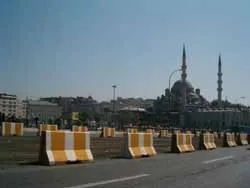
The longer the notorious "war on terrorism" lasts, the more explosions ring out in countries where many Westerners traditionally used to spend their holidays: in Turkey and Egypt, on the island of Bali and in Tunisia – indeed, almost everywhere. Terrorists are quite clear about the purpose of their actions: they are not very interested in the number of dead and wounded – they need to scare everyone else. So that they don't come and spend their money, thereby boosting the economy of one country or another.
The tourist flow to Turkish resorts this summer has decreased by 6% as of today – and yet the country's authorities are bending over backwards not to scare away vacationers: the media report explosions very sparingly, officials prefer to talk not about the number of victims but about the measures taken to protect against terrorists, and prices have noticeably gone down.
Actually, the latter phenomenon can perhaps be considered the surest sign of a resort country where the situation is tense and where, alas, the smell of gunpowder is increasingly palpable. The first time such a phenomenon was observed was in Indonesia: several years ago, after the explosions on the islands of Bali and Djerba, holiday prices there literally collapsed – by a third overnight. The terrible Christmas tsunami of 2004 also did not add to the attractiveness of these latitudes, and many still remember television reports about tourists being greeted by locals as benefactors, with tears in their eyes – because they brought them their income, without which many would simply go hungry. And Sri Lanka, which suffered the most then, moreover, still remains under the threat of terrorist attacks by the Liberation Tigers of Tamil Eelam.
Now the same phenomenon is observed in Israel and Lebanon: European tour operators are offering trips to these countries almost for free. The resorts of Eilat became deserted after the residents of the north of the country, who were quartered there during the war with Hezbollah, left. The ancient cities of Tyre and Sidon emptied – "breakfast under bullets" is damn good for musketeers, but the average vacationer, especially with family, can hardly be attracted by it. And the blue sky, hot sun, and 27-degree seawater go to waste.
Terrorist attacks primarily hurt the economies of tourist countries, preventing them from raising the extremely low standard of living of the majority of the population. And where there is poverty, it's a breeding ground for extremism of any kind.
In this regard, Turkey has been particularly unlucky: if in other countries terrorists are usually of one variety (for example, only separatists or only Islamists), here there are three varieties at once. First, the Kurds, who want to found (or revive – that's a matter of terminology) their own state of Kurdistan, which, in their view, includes not only part of Turkey but also large chunks of Iraq and Azerbaijan. Second, Turkey's own Islamic radicals, who hate the secular regime of Turkey and dream of a "state of Allah." In recent years, they have been joined by militant nationalists seeking, no less, the revival of the Ottoman Empire from Jerusalem to Vienna, from North Africa to Bulgaria.
Speaking of Bulgaria. Perhaps this is one of the very few countries where low holiday prices do not necessarily imply a terrorist threat. But it has its own problems: Bulgarian and Montenegrin resorts fall far short of international standards in many parameters. It's a bit dirty, hotels will seem comfortable only to unspoiled citizens from the former USSR who still remember "how it was" in Soviet times, and the service level leaves much to be desired (of course, there are exceptions, but they are exceptions).
Therefore, at the moment, the most attractive places for those who want to relax without "extremes" are the more expensive European resorts. Hungarians have already raised prices for holidays on Lake Balaton, in Latvia vacations on the Jurmala beach have become more expensive, the French Riviera has always been a not-cheap pleasure, and until recently relatively cheap Spain, after the "pacification of the Basques," has climbed up the resort price scale (except for Majorca). The same goes for Italy, Portugal, Croatia... Of course, expensive does not automatically mean safe, but the chances of a trouble-free holiday at expensive resorts are much higher.
However, as the players of the "champion" KVN team from Minsk used to say, "in reality, not everything is as bad as it really is." There is one pleasant exception – Greece. Trips here are still relatively cheap and attract a mass of European tourists. Both the mainland resorts and the islands, such as Crete and Rhodes, have been and remain fun, comfortable, hospitable, safe, and most importantly – affordable in terms of prices for the average vacationer.
Boris ALTNER.
IA Rosbalt