
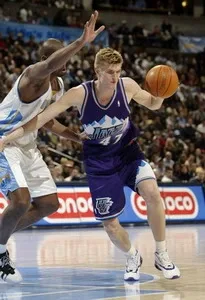
Double Hopes
Andrei Kirilenko (and we are talking specifically about the forward for Utah Jazz and the Russian national team) stepped up to the next rung of his career every year, and with each new season reached a higher level of readiness, motivation, and capability. In short, he was consistently approaching star status. Not a contrived one, but a genuine one – a world-class basketball star.
But at the same time, the 23-year-old has plenty of time to improve already excellent individual achievements and add to the collection of trophies won with his teams. Both the Russian national team and the overseas Utah Jazz are going through a period of generational change. And in both squads, coaches are betting on Kirilenko, who so far has not let his mentors down. And if his leadership on the national team at the 2003 European Championship could be put down to a mere coincidence of circumstances (theoretically, most strong basketball players can peak and deliver a very high-class performance over one or two weeks), then his status as Utah's leader is hard to argue with.
After the departure of legendary basketball players John Stockton and Karl Malone from the Jazz camp in the summer of 2003, team coach Jerry Sloan began building a new formidable Utah. The coach deliberately gave up the idea of making the playoffs at all costs, relying more on the gradual progress of his young charges. But Kirilenko, Arroyo, Ostertag, and others immediately rejected the notion of a grace period and started proving that the team based in the Mormon city was not strong only because of Stockton and Malone.
Among the Mormons
The athletic side of Kirilenko's life was rapidly gaining momentum and moving forward and only forward. A native of Izhevsk and an ordinary St. Petersburg schoolboy, he joined a basketball section at the age of seven at the invitation of a coach who had dropped by their school. Over time, the orange ball and the backboard with the rim became the meaning of his life, and now they are repaying the basketball player for his loyalty to the game and his persistence in conquering heights. In the form of victories at various levels – from the Russian youth championship to the Russian Super League championship and recognition as the best player of the season.
"When I was little," Andrei recalls, "and had just started playing basketball, I dreamed of getting into some good team. At first, that team was St. Petersburg's Spartak, then Moscow's CSKA. So it turned out that I played a year for Spartak, received an invitation to CSKA from Stanislav Eremin to try myself in the army club. So everything I dreamed about came true. And now I'm playing in the NBA. And that is also the fulfillment of a dream, because I consider playing in the American league a significant step forward in my development as a basketball player. Don't think that I've become conceited or 'caught the star'. I'm generally self-critical and think that whatever results I show, I'm far from perfect. There are plenty of shortcomings in my game – I lack physicality, and my shot is not consistent. So I still need to work and work. My future in the NBA depends entirely on myself."
So far, Kirilenko has not stopped in his development and is certainly the kind of role model that parents often use when appealing to the conscience of their children who have strayed from the right path. Similarly, one can assume that the fair half of humanity who speak Russian and are at an age capable of interesting a 23-year-old young man would not mind luring the basketball player into their nets.
But, alas, 99.9% of interested ladies are too late. Andrei is married. Moreover, his love story is quite interesting. If only because his wife, Masha Lopatova, before meeting Kirilenko, dated Andrei Grigoriev-Apollonov – the Redhead from Ivanushki. True, the capricious and fickle chart-topper at some point fell out of favor with her, and then a calm and reliable basketball giant appeared nearby. The daughter of a basketball player (Masha's father, Andrei Lopatov, once played for the USSR national team) and a promising hairdresser-stylist quickly charmed the already super-famous athlete. And soon the Kirilenko couple moved overseas. But they did not break ties with their homeland. For example, Andrei, Masha, and... Redhead starred in a video for the super project Malo in 2002, produced by Fyodor Bondarchuk.
In the USA, Kirilenko ended up in Salt Lake City, the famous city of Mormons, followers of a peculiar religious movement. Utah is a very puritanical state (there are no discos or nightclubs in the center). At first, when he lived there alone, without his family, he was terribly bored. Andrei simply hated this city. He sat in his hotel and didn't know what to do. But then Masha arrived, favorite places appeared – little restaurants, cafes, a movie theater – and everything improved. And when his son Fedya was born in February 2002, there was no trace of boredom left. Moreover, even now Kirilenko is thinking about the future of his heir: "If Fedenka continues to live in America, he will certainly become some kind of athlete. The USA has all the conditions for sports. We bought him a small basketball, and he is already trying to dribble and shoot."
And now, in Andrei's daily routine, there are two main themes – basketball and family. "For me, family is everything," says the star basketball player. "I love attending all sorts of events and presentations with my wife, going to restaurants, clubs, concerts. The main thing is that we are together. True, during the NBA season it didn't work out as often as I would have liked. But on vacation we never parted. I love talking to my son. I really like it when he smiles. At such moments, I realize that I don't need anything else."
However, regarding “we don’t need anything else,” Andrei was clearly exaggerating. He does not want to stop growing. And when basketball matters require it, he is ready to sacrifice the interests of his family. For example, during a break in the championship, the Kirilenko couple planned to rest for a couple of days in Florida, but the call to participate in the star weekend ruined everything. For the third year in a row, Masha has failed to rest with her husband in the winter. But she does not complain. After all, being a participant in the All-Star Game is very honorable and important for her husband.
The young married couple had until recently rented half of a two-story mansion in the suburbs of Salt Lake City. Moreover, the concept of “suburb” is stretchable. The drive to the Sports Palace is only 15 minutes.
By the way, the tendency to measure distance in time, not in kilometers, often visits Kirilenko. “I love to drive and drive fast. What Russian does not love fast driving? Once in Salt Lake City I sped up to 200 miles per hour (about 322 km). Good thing there were no policemen nearby. But after that I realized that I have a wife and a child. I don’t drive that fast anymore. And I have been fined in America only once, when I was driving at 94 miles per hour (151 km), exceeding the limit by 50 miles. A receipt came by mail – a fine of $300.”
Star of the “Jazzmen”
Kirilenko is considered the most talented Russian basketball player of the last quarter century. Now that he has truly great fame, Andrei is certainly very glad that in his time he did not chase the long ruble to the Greek Panathinaikos. The American press never tires of admiring the basketball player’s ability to make spectacular block shots, and Utah coach Jerry Sloan always emphasizes that the Russian is also strong in positional defense, in help defense, and in attack.
But achieving recognition in the NBA is not easy. It is not enough to be talented from birth. You have to work on yourself in a very intense rhythm, not show weakness in relations with competitors, and at the same time maintain clarity of thought in communication with the press.
“My daily routine is quite simple. Wake up at 7:30 a.m., light breakfast, leave for training. At 8:15 I am already at the doctor’s; he applies tapes – special protections to prevent twisting my feet – and rubs my arms and legs with special warming ointments. If there is an injury, I come even earlier to get treatment. At 9 o’clock I go to the gym, where I do a light warm-up. And from 10 o’clock training begins and lasts about two hours. At 12:00 it ends, and I am free.
This daily routine differs significantly from what it was at CSKA. In Russia we played once or twice a week, and the rest of the time we trained. We had very hard training twice a day. What else distinguishes the NBA from CSKA is the relationship – coach-player. In America, a player will never allow himself to talk to the coach in raised tones during training, or even argue. And the coach himself during training and after are two different people. He is tough on the court, he can pressure you, but as soon as the training is over, he becomes a cheerful, nice person without any touch of self-importance.
Hazing? No, the teams have serious guys. They look at the newcomers and draw their own conclusions – who is capable of what. A lot becomes clear after the first training session. And after a week – what kind of person he is, how he behaves in the team. If he gets too big for his britches, the old-timers will find a way to cut him down. That happens, and then player trades have to be made.
The relationships between whites and blacks turn out to be interesting. African Americans show their superiority over whites (for them basketball is not a sport but a way of life). And if a white person does not give a rebuff, does not beat them, they start mocking. But in Utah there are no problems. We only joke about it: we good-naturedly call them niggers, and they call us white trash or suckers.
In the NBA, by the way, not everyone is a megastar. Everything rests on 15-20 guys, and the rest are just very good players who can be struggled with and beaten. But each club has strong marketing and PR services with a huge staff that promote the club’s players in the press and on television, because the basis of everything is the show. If in Russia the sports result is more important, then in America we work for the show.”
In the All-Star Game itself, which took place on February 15 (three days before Kirilenko’s birthday), Andrei spent 10 minutes on the court. During this time, the Russian threw the ball three times (one hit), scored two points, and made one rebound. Honestly, not the most impressive numbers. But for a debut – both personal and all-Russian – these numbers are not so important. Much more significant is the very fact of a Russian player’s presence among the elite of world basketball.