
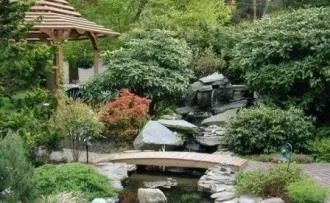
Japanese gardens remain attractive throughout the year. Evergreen plants are used for their design. Such gardens do not excite perception, but soothe and pacify. They look great in small spaces and are easy to maintain.
The Japanese garden is full of life, spiritual, inviolable, sacred, it resembles the surrounding nature, allows you to focus on your inner self, relax after a working day, break away from the hustle and bustle, feel connected to the world.
The Japanese garden is not just an object of architecture and design. Space, silence, time, an atmosphere of contemplation, nuances of color – all these elements belong to a subtler realm than the notorious design and architectural functional developments.
Use of stones and water in the garden
Stones are a symbol of mountains and the positive male force Yang. Water is quiet lakes and fast rivers, symbolizing the dark but soft female force Yin. Ancient cosmogonic dualism states that the basis of the world's existence is their constant opposition and unity.
Water is life and purification. It murmurs, reminding everyone of the transience of time. A humpback bridge thrown over a stream or pond is a transition between worlds.
Vegetation of the Japanese garden
All plants mean something. For example, pine is a symbol of courage, bravery, it shows the ability to overcome difficulties. Maple is a symbol of greatness, eternity, delicacy and wisdom, jasmine – warmth and comfort, sakura – love, friendship, fidelity and high spirituality. Fruit trees embody beauty and joy, moss – protection, patronage and reliability. Wild grapes and ivy are symbols of sincerity and loyalty to ideals. The Japanese garden must be well-groomed and attractive at any time of the year, so pyramidal, columnar, arbitrarily overgrown plants are not allowed. Neat evergreen vegetation is chosen.
If there is an empty space 'ma' in the garden, it is covered with a carpet of sedums or moss. An obligatory plant of the garden is bonsai, symbolizing a maximally compressed reflection of spiritual reality. Bonsai, like the Japanese garden as a whole, are considered an artistic embodiment of worldview.
An integral attribute of the Japanese style is gazebos. They are made of natural materials, their meaning is to encourage contemplation, create calm and tranquility. The most magnificent views should open from the gazebos.
Also, bamboo and reed bridges are built in gardens. Bamboo is a sacred plant, so preference is entirely given to it. For the Japanese, bamboo is a symbol of health, constancy and longevity. Bamboo is also very strong, so it is widely used for building various structures. The bridges are not decorated so as not to weigh down the light structures.
Despite the fact that Japanese garden art was influenced by Chinese, it is a unique phenomenon. In relation to nature, the Chinese have a prevailing view of philosophical reason, while the Japanese have an emotional and aesthetic experience. A garden made in the Japanese style is a corner of peace in the modern developed world.
In our world, most people are constantly worried about work, home, family, money. An island of nature, namely a Japanese garden, will be a spiritual haven where you can rest from daily negative impressions.
_