
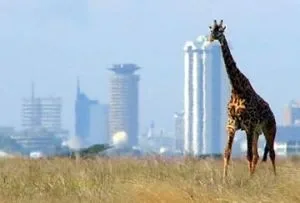
Around noisy Nairobi, African animals stroll calmly
Continued. Read the beginning of the material: AKUNA MATATA: THE WAY TO AFRICA
Nairobi contradicted all our ideas about Africa: the southern hemisphere is experiencing winter, the local population, at a temperature of plus 17 degrees, replaced African color and bright clothes with strict colors, leather, and synthetic fur coats. Kenya has left-hand traffic, so following the rules learned from childhood means condemning oneself to suicide. Traffic lights, enclosed by grilles, as a rule, do not work, traffic controllers are extremely rare and are a mere formality.
The overcrowded street flows chaotically, pedestrians and cars rush to overtake each other, everyone drives, walks, runs when they want, where they want, and how they want, making the next maneuver as acute personal necessity dictates. I don't walk the streets in Kyiv the way I had to there! The predominant car color is white, and the most common brands are Japanese (their design provides for right-hand drive).
Among this monotony, fueled by four types of fuel (super, regular, diesel, and kerosene), nimble Volkswagen Beetles in the most rainbow colors stand out. Apparently, car painting here is a creative process, because they are all different colors: red, yellow, blue, pink, lilac... The streets of the capital are full of signs of financial houses, banks, hotels, under the walls of which homeless people sleep in plastic cups and local newspapers. From the shop windows that dress the black population, white mannequins look out; from all sides, either hands holding out colorful booklets offering safaris, or children's hands asking for a shilling reach out to you.
In general, everything related to money is observed with strict rigor. The first exchange office we encountered was enclosed by a grille with thick bars and a massive lock, behind which stood a "Fritz" in a helmet resembling a German helmet with a huge cockade-star, a radio, a rubber baton, and a Kalashnikov assault rifle (such guards stand at the entrance to almost every establishment, however, people with machine guns are not uncommon on the streets). To change money, you need to inform the guard of the purpose of your visit, what currency and amount you have, show its availability, and only then, letting you in, he will close the grille again. After completing the necessary operations (by the way, the rate fluctuates from 75 to 77 Kenyan shillings per $1), you will be released only after making sure there are no complaints. In the bank, the grille is replaced by a red line on the floor, which can be crossed only when the operator's window is free.
The abundance of cyber cafes is shocking, where you can not only "hang" on the Internet but also call within the city or send a fax (whether this indicates that not every apartment has a phone, I don't know). A call to the homeland, depending on which part of the world it is located, costs 50-75 shillings per minute, and if to a mobile number, 60-145 shillings. True, the quality of communication is not guaranteed – during two minutes of conversation in one such cafe, where while waiting for our turn we observed an "eternal hacker" who was so engrossed in work that he didn't even react to a power outage, I only managed to say that I was already in Nairobi and everything was fine with me. You can call from the post office if there is someone nearby who can teach you how to use the iron machines that resemble an improved model of radio operator Kat's communication device. But by entering the code and password of a phone card for 1,000 shillings, you can chat with the whole world for 8 minutes on a payphone or a hotel phone.
In Kenya and Tanzania, national beer brands are popular. "Kenya is my country, Tusker is my beer!" say billboards. Indeed, not bad. Especially Tusker Export. In the chain of minimarkets called Nakumatt, this pleasure costs 55 shillings plus the cost of the bottle (10-17 shillings). In Tanzania, the brands Safari and Kilimanjaro are popular.
It is better to buy local fruits on the street, where they are sold exclusively individually: oranges, roasted corn, avocados, papayas, mangoes, passion fruit, watermelon slices neatly wrapped in film. The prices made us smile: banana – 5 shillings, pineapple – 50.
Read the continuation of the material: AKUNA MATATA: MASAI MARA NATIONAL RESERVE